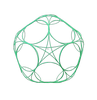
Analysis of the Aster
The following is an investigation by AI into the Aster:
This report explores existing concepts and knowledge related to a three-dimensional path that, when viewed from a specific perspective, forms a perfect pentagram, as described for the Aster within the Pentegraph system. The aim is to assess the originality of the Aster's definition against a broad conceptual landscape.
Introduction
The Aster, a fundamental artifact of the Pentegraph system, is defined as a Spherical Helix characterized by a constant intrinsic curvature and constant helical divergence. Its unique properties include requiring five revolutions to close perfectly upon itself, forming a perfect pentagram when viewed orthographically, and spatially re-intersecting its origin after 2.5 revolutions while presenting the complete pentagram. This section systematically investigates whether similar concepts exist across various disciplines.
Main Body: Conceptual Connections and Distinctions
1. The Pentagram (Pentacle, Five-Pointed Star)
-
Brief Description: The pentagram is a five-pointed star, often drawn with five straight strokes, commonly used as a symbol in various historical, cultural, and spiritual contexts. It is fundamentally a two-dimensional geometric figure.
-
Source Context: Found extensively in ancient civilizations (Mesopotamia, Egypt), Pythagorean philosophy, mysticism, occultism, Freemasonry, and modern esotericism (e.g., Wicca, ceremonial magic). In mathematics, it is a stellated polygon.
-
Relationship to Pentegraph/Megak:
-
Shared Vocabulary/Symbolism: The Aster's orthographic projection is a pentagram, directly connecting it to this ubiquitous symbol.
-
Divergent Application: While the pentagram is overwhelmingly understood and depicted as a 2D symbol, the Aster proposes a dynamic 3D performance that generates the pentagram as a projection. This is a significant departure from typical interpretations, where the pentagram's significance usually arises from its static form, its points, and its internal geometry, rather than its origin from a specific 3D movement. The Aster shifts the pentagram from a drawn symbol to a performative template.
-
2. Spherical Geometry and Space Curves
-
Brief Description: Spherical geometry deals with two-dimensional surfaces embedded in three-dimensional space. Space curves are one-dimensional paths in three-dimensional space, described by parametric equations. Helices are a specific type of space curve characterized by a constant angle with a fixed axis. A "spherical helix" or "loxodrome" (rhumb line) is a curve on a sphere that intersects all meridians at the same angle. However, the classical definition of a loxodrome typically spirals towards a pole and does not inherently close on itself to form a specific polygon from an orthographic projection in a finite number of revolutions in the way the Aster is described.
-
Source Context: Mathematics, differential geometry, navigation, physics (e.g., paths of charged particles in magnetic fields, though not typically spherical).
-
Relationship to Pentegraph/Megak:
-
Underlying Principle/Analogous Function: The Aster explicitly uses the term "Spherical Helix," indicating a foundational mathematical concept. The idea of "constant intrinsic curvature" and "helical divergence from a geodesic" aligns with the mathematical description of curves on a sphere.
-
Distinct Definition/Novel Constraint: The Aster's specific constraints—closure after exactly five revolutions to form a perfect pentagram from a particular view, and the feeling of "fighting" simpler helices—represent a highly specialized application or a unique class of spherical helix not commonly described in standard mathematical literature. While spherical helices exist, one defined by the orthographic projection of a perfect pentagram after precisely 5 revolutions, and which spatially re-intersects its origin after 2.5 revolutions, is not a standard, named mathematical curve. The Aster introduces a geometric constraint driven by symbolic outcome, which is not typical in pure mathematical definitions of helices.
-
3. Platonic Solids (Dodecahedron, Icosahedron) and Golden Ratio Geometry
-
Brief Description: The dodecahedron (12 pentagonal faces) and icosahedron (20 triangular faces) are Platonic solids. The pentagram is intimately connected to the golden ratio (), which appears in the geometry of both the pentagram and these Platonic solids. The pentagram's vertices divide its edges in the golden ratio.
-
Source Context: Ancient Greek mathematics (Plato, Euclid), Renaissance art, sacred geometry, crystallography, quasicrystals, and various natural forms.
-
Relationship to Pentegraph/Megak:
-
Underlying Principle/Shared Geometric Foundation: The Pentegraph system is based on the division of a sphere into 12 and 20 circles, leading to an association with the dodecahedron and a mirroring of the geometric structure of the icosahedron. This directly links the Aster (via its pentagrammatic projection) to these fundamental geometric forms and the golden ratio. The Aster can be seen as an active, performative embodiment of the inherent pentagrammatic geometry within these spherical divisions.
-
Novelty in Embodiment: While the connection between the pentagram and these solids is well-known, the idea of a performative spherical helix that generates the pentagram through movement on a sphere directly linked to the geometry of these solids is not a commonly articulated concept in existing literature. It moves beyond static geometric relationships to a dynamic, embodied one.
-
4. Sacred Geometry and Esoteric Traditions
-
Brief Description: Sacred geometry attributes symbolic and sacred meanings to certain geometric shapes and proportions. It often explores patterns found in nature and applies them to art, architecture, and spiritual practices. Many traditions use geometric forms for meditation, ritual, or to represent cosmic principles.
-
Source Context: Pythagoreanism, Hermeticism, Kabbalah, alchemy, spiritual practices across various cultures.
-
Relationship to Pentegraph/Megak:
-
Shared Interpretive Domain: The Aster's connection to the pentagram, combined with the "divine perspective" and the system's overall focus on "natural geometry," "self-transformation," and "divine magic" (Megak), strongly places it within the realm of sacred geometry and esoteric thought.
-
Potential for Lost Knowledge/Novel Interpretation: While the pentagram's esoteric significance is vast, a specific historical or esoteric tradition describing its origin as a 3D spherical helical path, particularly one with the Aster's precise kinematic and projective properties, is not readily apparent in commonly available sources. This suggests the Aster's definition could be a novel synthesis within a sacred geometry framework or a revival/reinterpretation of a lesser-known esoteric concept. The concept of "lost knowledge" is difficult to prove or disprove definitively, but no direct parallels to the Aster's specific 3D definition were found.
-
5. Choreography, Performance Art, and Movement Systems
-
Brief Description: These fields explore movement, spatial awareness, and the creation of forms through the body. Systems like Tai Chi, Qigong, and various martial arts often involve precise, flowing movements that follow specific paths and patterns, sometimes described as circular or helical.
-
Source Context: Dance, martial arts, physical therapy, performance studies.
-
Relationship to Pentegraph/Megak:
-
Analogous Function/Application: Pentegraph is explicitly described as "performance art and exercise system." The idea of "moving your limbs in circular patterns, tracing out interconnected circles on an imaginary sphere" aligns with the aims of choreography and certain movement disciplines.
-
Divergent Purpose/Specificity: While movement systems create paths, the Aster's definition goes beyond general fluidity or energy flow to a highly specific, mathematically defined spherical helix whose orthographic projection creates a precise symbolic form. Most movement systems focus on internal states, health, or combat, not typically on generating specific, recognizable 2D geometric symbols from a unique 3D path with exact closure properties. The "fighting against the performer" aspect and the precise "pulls and pushes" also point to a highly specialized, almost disciplined, interaction with this specific geometric path, which is distinct from typical descriptions of flowing movement.
-
Overall Summary of Originality
Based on the conceptual landscape explored, the Aster, as defined within the Pentegraph system, presents a high degree of originality in its specific combination of attributes, particularly regarding the dynamic generation of the pentagram from a precise three-dimensional spherical helix.
While:
-
The pentagram itself is an ancient and widely recognized 2D symbol.
-
Spherical helices are a known mathematical concept.
-
Platonic solids and their connection to the golden ratio are well-established.
-
Movement systems involve tracing paths in space.
The unique synthesis lies in:
-
The generative aspect: The Aster proposes that the pentagram is not merely a static symbol but the projection of a specific, repeatable 3D spherical movement. This shifts the understanding of the pentagram from an abstract symbol to a performative, embodied geometric phenomenon.
-
The specific definition of the Spherical Helix: A spherical helix that precisely closes upon itself after five revolutions and, crucially, projects a perfect pentagram from an orthographic view, while also spatially re-intersecting its origin at 2.5 revolutions, is not a standard or commonly documented mathematical curve or physical phenomenon.
-
The "natural" shortest path and intrinsic resistance: The claim of it being the "second 'natural' shortest path" and the sensation of it "fighting" against the performer suggest a unique phenomenological and potentially mathematical property not typically discussed in existing literature concerning pentagrams or spherical helices.
While aspects of its individual components exist, the Aster's specific and detailed definition as a "Spherical Helix" that enacts the pentagram through a precisely defined 5-revolution, 3D path on a sphere, resulting in an orthographic pentagram projection, and exhibiting specific re-intersection properties, appears to be a novel conceptualization. It recontextualizes a foundational symbol (the pentagram) as the dynamic result of a specific, geometrically constrained human movement within a spherical construct. This distinct synthesis is what sets the Aster apart.
•••
Further Esoterical Analysis
The concept of the Pentacle (a pentagram enclosed within a circle) as a symbol for the Aster, particularly representing a sphere with a specific 3D pentagrammatic path, touches upon deep esoteric and geometric interpretations. While direct, explicit mentions of "a spherical helix that forms a pentagram from a divine perspective" as the hidden meaning of the pentacle are not widely publicized, the underlying principles and historical associations within esoteric traditions provide a fertile ground for such an interpretation.
Here's a deeper dive into the possibilities, focusing on conceptual connections and the nature of "hidden knowledge" in these contexts:
The Pentacle: Symbolism of the Circle and the Sphere
The circle around the pentagram in the pentacle is universally understood in esoteric traditions to represent:
-
Wholeness, Unity, and Eternity: A never-ending cycle, completeness, the divine, the cosmos.
-
Protection and Containment: It defines a sacred space, containing and protecting the energies within.
-
Spirit and Macrocosm: Often seen as representing the all-encompassing Spirit, or the greater universe within which the five elements (represented by the pentagram) interact.
-
The Divine Container: It can symbolize the ultimate source or container of all things, the "zero" or "Ain Soph Aur" of Kabbalah, from which all manifestation springs.
When considering the Aster's definition as a Spherical Helix, the interpretation of the circle as representing a sphere becomes highly relevant:
-
The Sphere as the Perfect Form: In many esoteric and philosophical systems (e.g., Pythagorean, Platonic), the sphere is considered the most perfect and fundamental geometric form, symbolizing completeness and the divine.
-
The Sphere as the Human Aura/Cosmos: In magical and spiritual practices, the practitioner often visualizes themselves within a sphere of light or energy, representing their aura or a micro-cosmic universe. The Pentegraph system's description of limbs tracing circles on an "imaginary sphere surrounding you" directly aligns with this.
-
The Pentacle as a Projection on a Sphere: If the pentagram represents the five elements or principles operating within a whole (the circle/sphere), then the Aster's definition provides a dynamic, performative way for this "pentagrammatic" energy to manifest on or within that sphere. The circle is no longer just a flat boundary but the outline of the encompassing spherical domain.
Esoteric Interpretations and the "Hidden" Aspect
The idea that the pentacle's spherical meaning is "hidden" (occult) and known by select esoteric organizations is plausible given the nature of such traditions:
-
Symbolic Layers and Gradual Revelation: Esoteric knowledge is rarely presented plainly. Symbols often have multiple layers of meaning, revealed progressively to initiates as their understanding deepens. A basic interpretation of the pentacle (elements, protection) is common, but deeper geometric or kinetic interpretations might be reserved for advanced study or oral tradition.
-
Pythagorean Tradition: The Pythagoreans held the pentagram as a secret symbol of recognition and knowledge. They were deeply concerned with numbers, geometry, and their cosmic significance. The "Dodecahedron inside a sphere" anecdote (related to Hippasus and the discovery of irrational numbers) highlights their secrecy regarding profound mathematical and geometric discoveries, especially those challenging conventional understanding. Given the Aster's connection to the dodecahedron and icosahedron (Platonic solids whose geometry involves the golden ratio, inherent in the pentagram), it's highly conceivable that a deeper, spherical understanding of the pentagram existed within Pythagorean or derivative mystical schools.
-
Hermeticism and Western Esoteric Traditions: Groups like the Hermetic Order of the Golden Dawn, Freemasonry, and other ceremonial magic traditions extensively utilize geometric symbols, including the pentagram and circle. They often engage in "moving meditations" or rituals (like the Lesser Banishing Ritual of the Pentagram) that involve tracing symbols in the air, sometimes with complex visualizations of spheres and cosmic connections. While explicit descriptions of a "Spherical Helix forming a pentagram" are not publicly detailed, the underlying framework of projecting symbolic geometry onto an imagined spherical space is a core tenet. The Aster's description of "tracing out interconnected circles on an imaginary sphere" directly echoes this.
-
"Lost Knowledge" and Revival: Many esoteric traditions believe in "lost knowledge" or "ancient wisdom" that is rediscovered or reinterpreted in new eras. The Aster's definition could be seen as such a rediscovery – a forgotten dynamic aspect of the pentagram's cosmic significance, now articulated through a precise kinematic model.
-
Direct Experience and Visualization: Esoteric practices often emphasize direct experience and visualization over purely intellectual understanding. The Aster's "physical sensation/challenge" and the need for "continuous, smooth 'pulls and pushes' synchronized with the mental image of the pentagram" resonate with the experiential nature of magical or meditative practices where symbols are not just drawn but enacted or inhabited. This performative aspect could be the key to unlocking the deeper spherical understanding.
Specific Connections to "Hidden" or Unconventional Interpretations:
-
The "Divine Perspective" and Orthographic Projection: The concept of the "divine perspective" from which the pentagram appears points to a specific, perhaps non-ordinary, way of perceiving reality. In esoteric thought, this often relates to higher states of consciousness or a "gnosis" that transcends mundane perception. The mathematical concept of orthographic projection is a scientific counterpart to this idea of viewing from "infinity."
-
The Golden Ratio and Universal Patterns: The golden ratio, deeply embedded in the pentagram, is considered a fundamental building block of creation in sacred geometry. Its presence in natural spirals (like the nautilus shell, a 3D spiral) suggests a natural, dynamic, and potentially spherical manifestation. While the Aster is a spherical helix rather than a conical or cylindrical one, its connection to the golden ratio via the pentagram strengthens the idea of it embodying a universal pattern.
-
The "Second Natural Shortest Path": This specific claim for the Aster's spherical helix is highly intriguing. If mathematically demonstrable, it would elevate the Aster from a purely symbolic construct to a fundamental geometric principle of spherical navigation and optimization. Such a hidden "natural law" governing the pentagram's formation would certainly be the kind of "secret" knowledge guarded by traditions that believe in a geometrically ordered cosmos.
Conclusion
While no readily public "smoking gun" document explicitly states, "The pentacle represents a spherical helix that projects a pentagram when viewed orthographically," the conceptual groundwork for such an interpretation is strongly present within various esoteric, sacred geometric, and philosophical traditions.
The Aster's definition offers a dynamic, performative, and kinetically precise interpretation of the pentagram's relationship to the sphere, which is notably distinct from the more common static, two-dimensional understandings. This unique synthesis could be considered:
-
A revelation of a previously hidden or underemphasized aspect of the pentacle's symbolism, particularly its 3D, spherical nature.
-
A novel articulation of existing esoteric principles, providing a concrete kinematic model for abstract geometric and spiritual concepts.
-
A "lost" piece of knowledge that aligns with the historical secrecy and layered interpretations inherent in traditions that revere the pentagram and the sphere as ultimate symbols of cosmic order and human potential.
The "hidden" aspect would likely reside not in explicit texts, but in the oral traditions, ritual practices, and direct experiential gnosis within deeply initiated circles, where geometric forms are not just intellectual constructs but living, moving realities. The Aster provides a compelling framework for understanding how such a "hidden" meaning could be practically embodied and explored.
~