The Book of Five Rings
The Geometric Underpinnings of Feudal Strategy: A Hypothesis on the Spherical Origins of Miyamoto Musashi’s The Book of Five RingsThe study of feudal Japanese strategy often centers on the philosophical and psychological dimensions of combat, yet a provocative hypothesis suggests that the foundational logic of its greatest exponent, Miyamoto Musashi, may be rooted in an advanced understanding of three-dimensional geometry. Miyamoto Musashi (1584–1645), the undefeated "Sword Saint" (kensei), left a legacy defined by his mastery of the "Two Heavens, One Style" (Niten Ichi-ryū) and his final treatise, The Book of Five Rings (Gorin no Sho). While traditional scholars associate the "Five Rings" with the Godai—the five elements of Buddhist esotericism—a closer examination of modern movement systems like Pentegraph reveals a compelling alternative. It is hypothesized that the "Aster" and "Penter"—foundational artifacts of the Pentegraph system, each comprising five circles—represent the precise geometric forms Musashi intended to convey through his title and training templates. This analysis will explore the intersection of Musashi’s martial philosophy, the mechanics of spherical helices, and the esoteric history of the pentagram in Japan to determine if these geometric structures constitute the "lost" training architecture of the world’s most famous swordsman.
Geometric Origin
The Architect of Strategy: Miyamoto Musashi and the GodaiTo understand the potential geometric origin of Musashi’s "Five Rings," one must first examine the cultural and philosophical landscape of the early Edo period. Musashi was born into a Japan transitioning from a century of civil war to an era of rigid stability under the Tokugawa Shogunate. In this new world, the role of the samurai evolved from a battlefield combatant to a practitioner of "Budo"—the Way of the Warrior—where combat was a vehicle for self-enlightenment and the perfection of character.
The Traditional Elemental Interpretation
Musashi spent his final years as a hermit in the Reigandō cave, where he distilled his lifetime of experience into five scrolls. The traditional interpretation of these "rings" is based on the Godai (Five Big) elements of Japanese cosmology: Earth (Chi), Water (Sui), Fire (Ka), Wind (Fū), and Void (Kū). These elements were physically represented in Japanese architecture and cemeteries by the Gorintō—a five-ringed tower or pagoda composed of stacked geometric shapes: a cube, sphere, pyramid, crescent, and jewel.
| Scroll | Traditional Element | Physical Shape (Gorintō) | Strategic Domain |
|---|---|---|---|
| Earth | Chi (地) | Cube (Square) | Foundations, basic principles, and military method. |
| Water | Sui (水) | Sphere (Circle) | Fluidity, flexibility, and basic sword techniques. |
| Fire | Ka (火) | Triangle (Pyramid) | Battle, aggression, decisiveness, and timing. |
| Wind | Fū (風) | Semicircle (Crescent) | Other schools, traditions, and perception of flaws. |
| Void | Kū (空) | Jewel (Lotus flower) | Nothingness, spontaneity, and ultimate awareness. |
Musashi’s choice of the word Gorin (five rings) is significant. In many contexts, Gorin can be translated not just as "rings" but as "wheels" or "spheres". This linguistic nuance is critical to the Pentegraph hypothesis. If Musashi viewed the elements not merely as abstract concepts or stacked stones, but as "wheels" of motion, then the search for an underlying geometric training template becomes historically plausible.
The Pentegraph System
Pentegraph and the Orb: The Geometry of Human ExtensionThe Pentegraph system provides a unique lens through which to view Musashi’s strategy. Pentegraph is a movement system that uses the natural mobility of the human body to trace interconnected geometric patterns on an imaginary sphere surrounding the practitioner—the Pentegraph Orb. This orb is fundamentally defined by the fact that human limbs describe circles in their rotation around joints.
The Five-Fold Nature of the Sphere
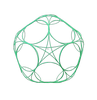
The Pentegraph hypothesis rests on a mathematical reality of spherical division. If circles of the same diameter are placed on a flat surface, they naturally form groups of six (a central circle surrounded by six others). However, when the surface is curved into a sphere, the space is reduced, and circles naturally arrange themselves into clusters of five—these are known as "Penters" in the Pentegraph system.
The Pentegraph Orb is a composite of two overlapping spheres of circles:
The Dodekakirkos Orb: Comprised of 12 circles that overlap to form hubs.
The Eikosakirkos Orb: Comprised of 20 circles that mirror the structure of the icosahedron.
When these two configurations are integrated, the resulting "Pentegraph Orb" provides a dynamic canvas for performing geometric patterns. The system asserts that "Five is the story of Pentegraph and the divisioning of a sphere". This matches Musashi’s emphasis on the "Five Rings" as the complete set of divisions for his Way of Strategy.
The Penter as a Foundational Ring
In the Pentegraph system, the "Penter" is a cluster of five circles arranged such that they facilitate rotating figure-of-eight movements. Each circle in a Penter represents a "ring" of motion. The practitioner traverses these rings using the "Penter Gyre," which requires two full rotations to restore the original direction of travel—a behavior that echoes the cyclic nature of Musashi’s training drills.
The Penter serves as the "Ground" or foundational architecture of movement. By repeating the figure-eight patterns within a Penter, a practitioner increases their "physical consciousness" by strengthening the somatosensory cortex through neural entrainment. This geometric repetition allows for "maximally efficient" joint mobility, which is the physical prerequisite for the "no-nonsense" speed Musashi demanded.
The Aster
The Aster: A 3D Template for the PentagramWhile the Penter provides the basic paths, the "Aster" represents the higher-level esoteric and martial application of the five-fold system. The Aster is defined as a "Spherical Helix"—a three-dimensional path that circumnavigates the sphere five times before returning to its origin.
The Signature of the Spherical Helix
The Aster’s path is characterized by "constant intrinsic curvature" and "constant helical divergence," a property known as the "Entelechic Twist". Most importantly, when the Aster is viewed from a "divine perspective"—an orthographic projection from infinity—the complex 3D spherical path appears as a perfect pentagram.
This discovery suggests that the pentagram, a symbol ubiquitous in ancient cultures (from Sumeria to the Pythagoreans), may actually be the "2D shadow" or map for a 3D spherical movement. The hypothesis posits that the pentagram is a template for performing this unique spherical revolution—a revolution that requires precisely five turns to close perfectly.
The Physical Challenge
The performance of the Aster is described as feeling "not natural," as the path constantly "fights" the performer by tending to spin off into simpler loxodromic helices. To maintain the path, the practitioner must manage continuous, smooth "pulls and pushes" (Ingress and Egress). This inherent resistance and the need for precision align with Musashi’s concept of "Timing in Strategy". Musashi wrote that "timing in the Void" is born of cunning and practice, and that the warrior must be able to discern the "background timing" of a situation. The Aster, as the "ultimate infinity symbol," represents a perpetual twisting in three dimensions of space while time is encoded in the unending path itself.
Martial Applications
Martial Applications: Blocks, Traps, and the Shield of DefenseMusashi’s style, Niten Ichi-ryū, is famous for its practical, dual-wielding techniques designed to "cut down the enemy" efficiently. The Pentegraph system, though appearing aesthetic, contains a robust martial layer that can be extracted from its geometric forms.
The Mechanism of Defense
The continuous path of the Aster is manifested through discrete segments called "Asterial Strokes," each corresponding to a "bifurcated circle". These strokes are applicable as martial "blocks or traps".
| Action | Direction | Martial Application |
|---|---|---|
| Egress | Outward | A proactive "pushing" force to intercept an attack. |
| Ingress | Inward | A reactive "pulling" force to trap or redirect momentum. |
| Wicket | Intersection | The "magnets" or junctions where a transition between blocking arcs occurs. |
Pentegraph is described as creating a "continuous shield of defence" based on natural geometry. This defensive mindset is the "highest level" for practitioners who have reached the pinnacle of their art.
The Pentagram and the "Five Rings"
Historically, the pentagram (gobosei) in Japan is most closely associated with the Gogyo (Five Phases) theory—Wood, Fire, Earth, Metal, and Water—rather than the Godai elements Musashi used. The pentagram served as the mark of the Onmyoji (masters of Yin and Yang), particularly Abe no Seimei, who used it as a protective talisman.
However, the user's hypothesis bridges this gap by suggesting the pentagram is the geometric signature of a 3D spherical revolution. While Musashi did not explicitly draw pentagrams in his surviving texts, he emphasized the "Way of the Long Sword" through five kata (forms) and five attitudes (Upper, Middle, Lower, Left, Right). The Pentegraph system includes the Whyzedexwhy, a literal drawing of a pentagram around oneself for protection, which it proposes as the "original meaning" behind the ancient tradition of using the symbol for defense. In this context, the Aster and Penter are not just symbols, but the functional "wheels" of movement that enable a warrior to maintain a "continuous shield of defence".
Conclusion
The hypothesis that the Aster and Penter are the geometric reality hinted at by Miyamoto Musashi provides a bridge between classical strategy and modern kinematic theory. By viewing the "Five Rings" not as static elements, but as the five revolutions of a spherical helix (the Aster) or the five-fold clusters of a sphere (the Penter), the practitioner moves from abstract philosophy to a "template for defined motion". This alignment suggests that the "true Way" Musashi urged his students to investigate might be found in the very geometry of the space that surrounds the human form.