Pentegraph FAQ
1. What is Pentegraph?
Pentegraph is a performance art and exercise system based on natural geometry. It involves moving your limbs in circular patterns, tracing out interconnected circles on an imaginary sphere surrounding you. These patterns, called Penters, Asters, and Gates, are based on the division of a sphere into 12 and 20 circles.
Pentegraph is not just about physical movement; it also emphasizes mindful awareness of these geometric patterns and their connection to the body's energy flow. This integration of physical and mental aspects can be explored through various techniques, including visualizing the patterns, synchronizing movements with breath, and using affirmations or mantras.
2. What are the basic elements of Pentegraph?
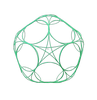
The fundamental elements of Pentegraph are called Artefacts, and are the Kirkos (circle), the Dykirkos (figure eight), the Penter (five interconnected circles), the Aster (a 3D circle projected as a pentagram), and the Gate (two interconnected Penters).
These elements combine to create more complex patterns like the Tortoiseshell and the Pentegraph Orb. Each element has unique characteristics and applications within the system, allowing for a diverse range of movements and practices.
3. What is the significance of the pentagram in Pentegraph?
The pentagram is not merely a symbolic element in Pentegraph; it serves as a template for the Esokirkos, also known as the Aster. The Esokirkos is a unique three-dimensional circle that wraps around a sphere, requiring five revolutions to return to its starting point. The pentagram acts as a two-dimensional guide for tracing this complex path, revealing the hidden geometry of spherical movement.
4. What are the benefits of practicing Pentegraph?
Pentegraph offers several potential benefits, including:
- Enhanced body awareness: The intricate movements and focus on geometric patterns cultivate greater awareness of your body's positioning and range of motion.
- Improved coordination and balance: The synchronized, flowing movements of Pentegraph help develop coordination and balance.
- Increased flexibility and strength: The circular motions engage multiple muscle groups and joints, promoting flexibility and strength throughout the body.
- Stress reduction and mental clarity: The meditative aspect of focusing on geometric patterns can induce relaxation and mental clarity.
- Creative expression: Pentegraph can be a form of expressive movement and artistic exploration.
5. Can Pentegraph be used as a martial art?
While not a traditional martial art, Pentegraph contains elements that could be adapted for self-defence. The continuous circular movements can be interpreted as defensive shields, and the principles of body mechanics and energy flow can enhance power and efficiency in movement.
However, Pentegraph primarily emphasizes self-mastery, control, and harmony of movement rather than aggressive techniques. Its potential as a martial art lies in cultivating awareness, fluidity, and the ability to move effectively within a spherical space.
6. What are Rhabdos and Tenthimbles?
Rhabdos and Tenthimbles are examples of "paraphernalia" used to enhance the Pentegraph experience. Rhabdos refers to the use of sticks or wands, rotated and manipulated in various ways to trace out Pentegraph patterns. This practice can help develop dexterity, coordination, and a deeper understanding of the geometric forms.
Tenthimbles involves placing luminous thimbles on your fingers and performing movements in the dark. This technique amplifies the visual aspect of Pentegraph, creating mesmerizing patterns and encouraging greater precision and control in finger movements.
7. What is the significance of the 'Ensemble' in Pentegraph?
The Pentegraph Ensemble refers to the application of Pentegraph principles and techniques in a broader context. It encompasses the understanding that every movement, whether in martial arts, dance, or daily life, follows a path governed by the body's natural geometry.
The Ensemble encourages exploration of Pentegraph patterns and movements in various forms, adapting them to different activities and integrating them into a holistic understanding of movement. It emphasizes the interconnectedness of body mechanics, energy flow, and spatial awareness.
8. Where can I learn more about Pentegraph?
By moving your mouse to the left of this page or clicking the symbol at the top left of this page or the one below.
~