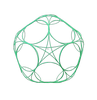
The Pentegraph Orb consists of two spheres of circles—the Eikosakirkos Orb and the Dodekakirkos Orb. But there are two ways of configuring the circles within each orb. The Eikosakirkos Orb has its circles touching each other while the Dodekakirkos Orb has its circles overlapping or crossing each other. Consequently there are two other versions, namely the Eikosakirkos Decussated and the Dodekakirkos Osculated.
Eikosakirkos Decussated
The Eikosakirkos Decussated has 20 circles which arrange themselves into groups of 3 and 5. Where they group into 3's, 20 triangles are produced. Where they group themselves into 5's, 12 pentagons are created.
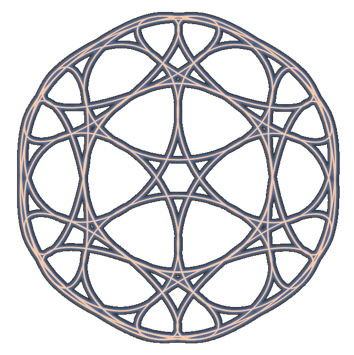
The Dodekakirkos Osculated (below) has its 12 circles form into groups of 3 producing 20 triangles.
Dodekakirkos Osculated
The Eikosakirkos Decussated and the Dodekakirkos Osculated join together to form the Apocryphal Orb below.
Apocryphal Orb
The Dodekakirkos Decussated and Osculated joined together below, show the boundaries of the 12 pentagrams and their extent and size within the circles. They form much larger circles than the 20 Eikosakirkos circles.
Apocryphal Orb
~
These configurations do not provide a useful structure for performance that I have discovered yet.
Below are all the orbs combined: the Pentegraph and the Apocryphal Orbs. Pretty, but pretty useless!
~
It is only the Pentegraph Orb where the circles have osculation allowing for continuous paths around the Orb, changing lanes as they go. The other orbs: Dodekakirkos Osculated and Eikosakirkos Decussated do not have usefully interacting paths—no osculation—when they are combined together. Even when all are combined into a 4 orb conglomerate, the resulting spaghetti is of no use at all other than being interesting! This is why they are called the Apocryphal Orbs, because they are hidden away as they are not true to Pentegraph performance.
The critical feature of the Pentegraph Orb (specifically the Eikosakirkos Osculated and Dodekakirkos Decussated configurations that constitute it) is that its circles touch and have osculation, which allows for the interweaving of the Penters in the Orb. This is fundamental to Pentegraph performance.
~