Pentegraph Orb
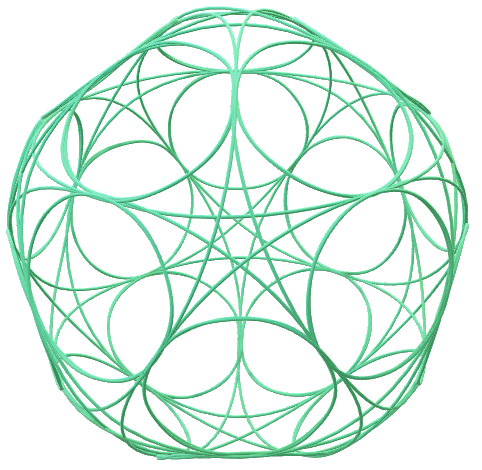
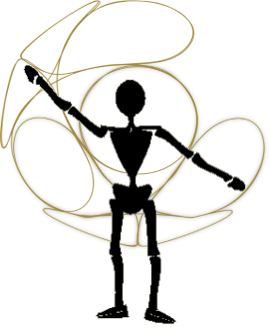
Our limbs describe a circle in their rotation around their joint and in 3 dimensions the circles create a sphere. The sphere forms a surface upon which we can draw. Wherever there is a joint in the human body, a sphere can be positioned around it and the limb will have partial ability to draw upon it.
The Pentegraph Orb is the template for the patterns that can be drawn around oneself, and when of a diameter equal to one's own height, create the right size circles for the drawing of the Penter's which are produced by its geometry.
Pentegraph is based upon the patterns that are created when you draw interconnected circles around oneself. It is a system of body movement based upon natural geometry
Our limbs describe circles at the limit of their extension, encasing us in a sphere.
It is the surface of this sphere that provides the dynamic canvas upon which we can draw.
~
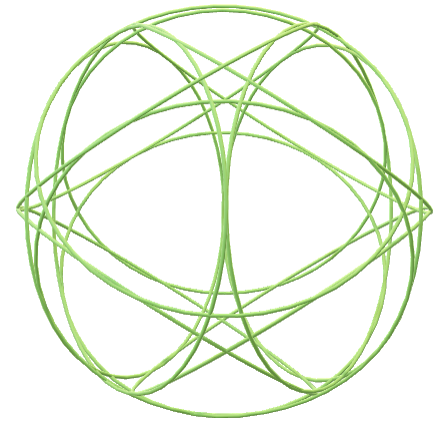
The Pentegraph Orb comprises of two overlapping spheres of circles. One of twelve circles, called the Dodekakirkos Orb, and one of twenty circles, called the Eikosakirkos Orb.
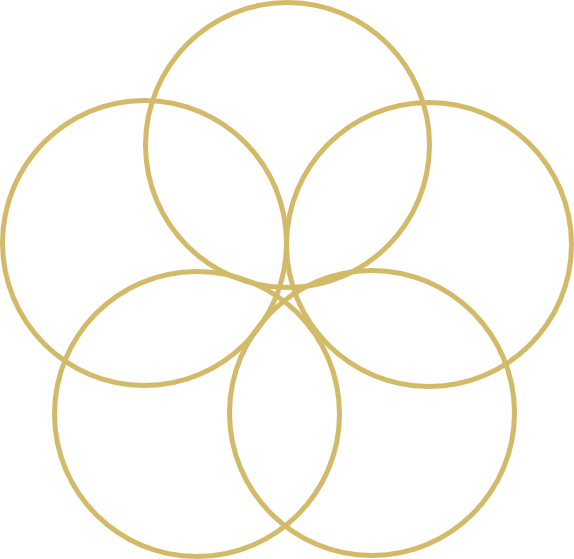
The Dodekakirkos Orb (right), is the most perfect geometry, constructing 12 pentagrams out of 12 circles! This is where the pentagram occurs in natural geometry. This is where the Inner Circle is discovered - the Esokirkos.
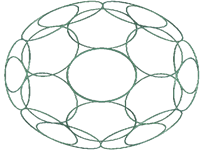
The Eikosakirkos Orb (left), is effectively an icosahedron with 20 circles instead of 20 triangles. These 20 triangles can each also be divided into 4 triangles giving an orb an equivalent of 80 circles (Ogdontakirkos, not illustrated), and can be further sub-divided into an infinite number of circles, but the 12 and the 20 circle orbs are the two simplest configurations that have circles all of the same size forming together into a sphere, with the 20 circle orb the equivalent of the Platonic solid of the icosahedron, which is the largest congruent structure.
The Dodekakirkos Orb with its 12 pentagrams, form the hubs around which the circles of the Eikosakirkos Orb are interconnected. The 2 Orbs joined together produce the Pentegraph Orb.
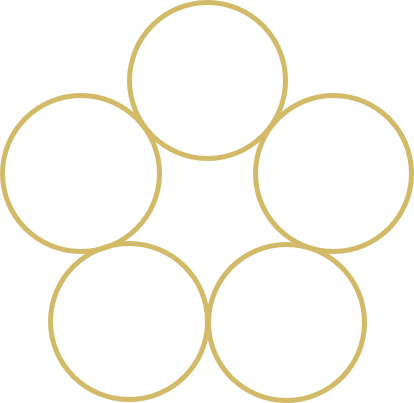
The surface of the sphere is divided into 12 clusters of 5 circles each, with each cluster forming a hub, around which circles are interconnected by paths. These clusters are called Penters, and are the natural pattern that form upon the surface of a sphere.
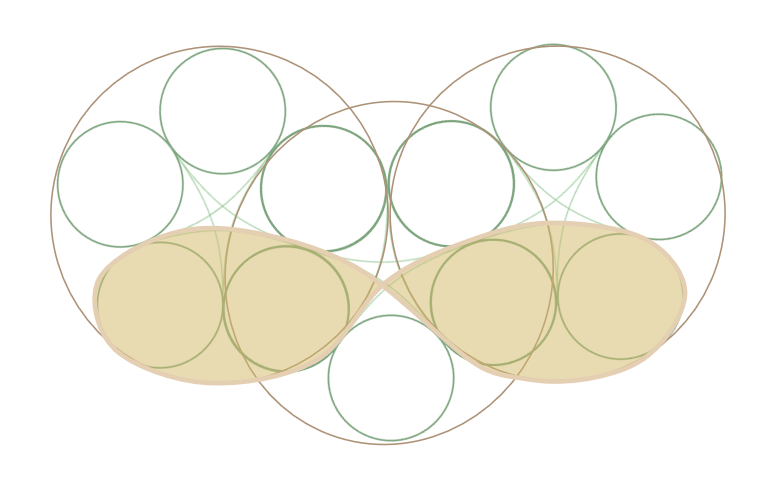
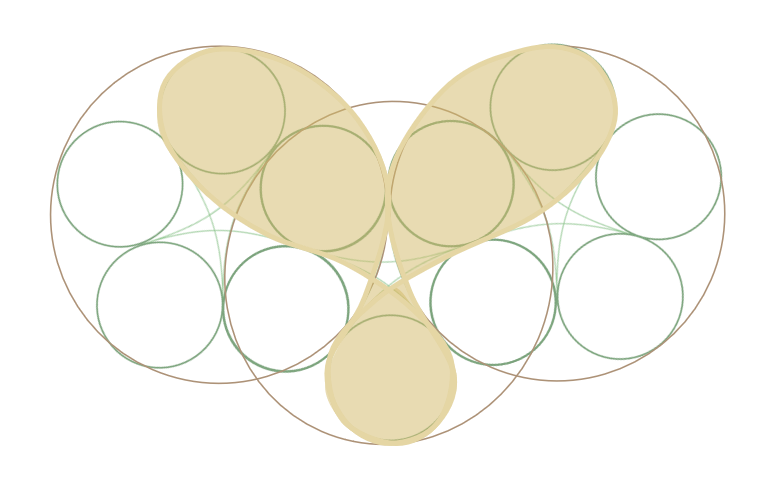
The Eikosakirkos Penter on the left and the Dodekakirkos Penter on the right, in their flattened forms showing how the 5 circles join together.
~
Hemispheres of the Orb
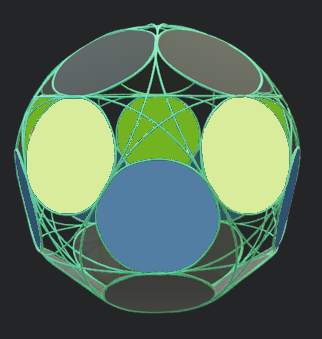
There is no actual line circumnavigating the Orb at its equator, just as there is no great circle from pole to pole. The Orb does not divide into two. But there are two Axial Bands created from two of the Dodekakirkos circles which produce two parallel horizontal divisions. Between these divisions there are 10 Equatorial Kirkoi (circles), five of which are predominantly in the upper hemisphere and five in the lower hemisphere (shown respectively in yellow and blue in the image to the right).
The upper hemispheric Penters all have the Anabasis Pentenexus at their hub with the point of the pentagram pointing upwards, and are known as Anabasis Penters, while the lower hemispheric Penters have Katabasis Pentenexus with their points pointing downwards, and are called Katabasis Penters. If the Orb was turned upside down, this would still be how it is.
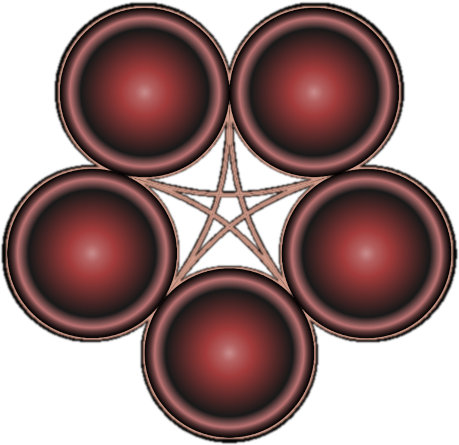
Anabasis Penter
Katabasis Penter
The Zenith Penter overhead is dependent upon which direction you are facing for its orientation, while the Nadir Penter is where you stand and so does not have a pentagram at its hub.
~
The Unravelling of the Orb
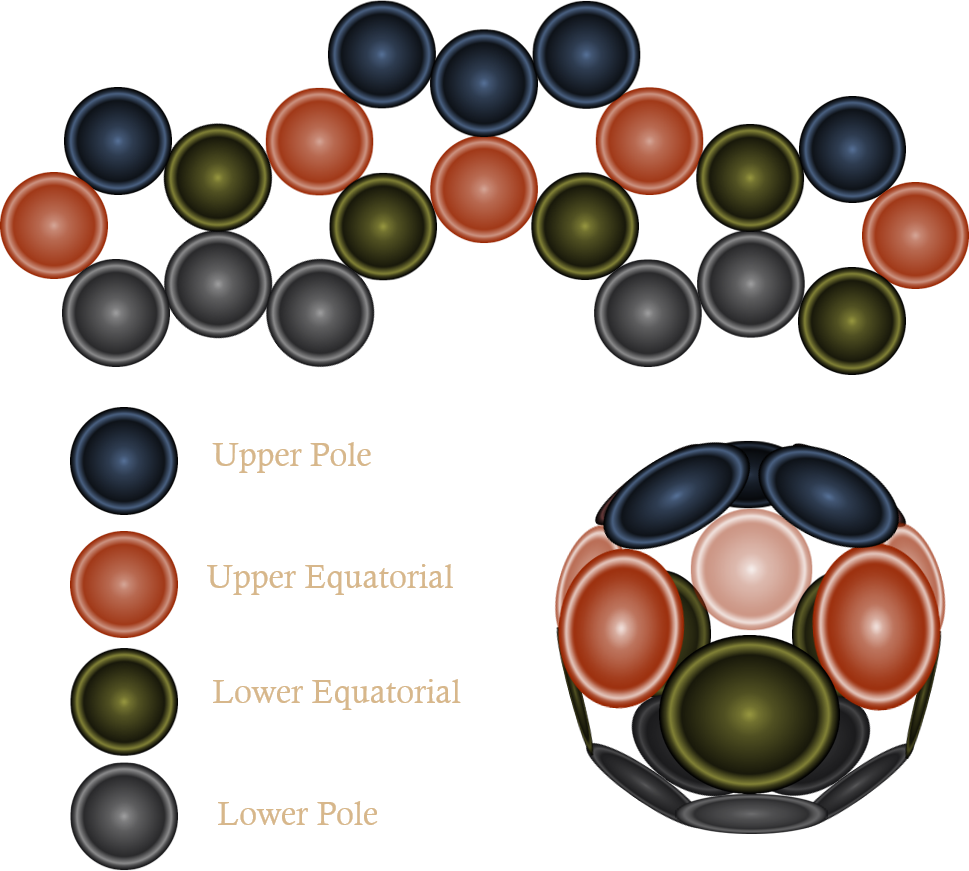
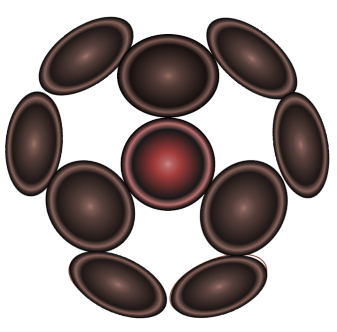
Unfortunately this unfolding does not produce a useful two dimensional template to depict the patterns that are inherent within the Orb. The largest structure that is possible to display in a flattened form is the Tortoiseshell and this is only possible with partial distortion due to the curvature of the sphere, as can be seen below:
~
Orb traversal
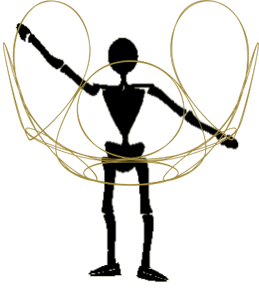
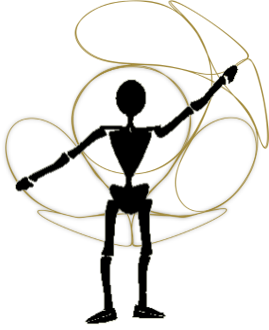
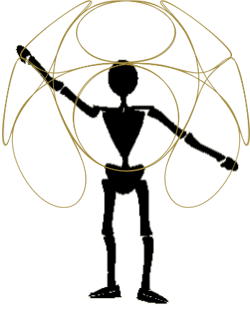
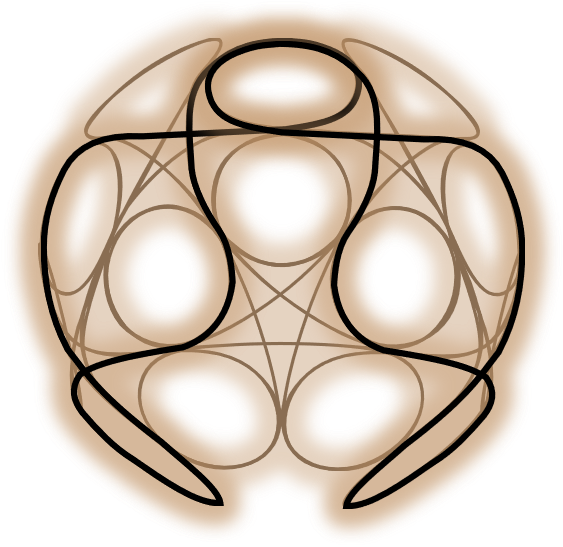
The traversal of the Orb entails using the Dragonfly alternating between Canted Gates and the lower and upper Gates. The Dragon Flies Eastward conserves the Dragonfly technique whilst missing out on some parts of the Penters to achieve a shorter traversal.
~
Orb Transpenters
~
~
The only true way of experiencing the Pentegraph Orb is by standing inside one, and other than constructing a full size one in your garage like I've done, the best way (and actually even better) is to use VR. The link below is made for the Meta Quest 3: