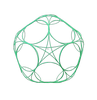
Pentegraph Codex
This document serves as the definitive technical exposition of the Pentegraph system. It systematically defines and articulates the fundamental artefacts, geometric structures, and operational mechanics that comprise this unique discipline.
The Pentegraph Codex meticulously details the Pentegraph Orb, a spherical construct that serves as the volumetric domain for all Pentegraph praxis. Within this framework, core artefacts such as the Penter — a five-circular geometric configuration — and the Aster — a three-dimensional Spherical Helix — are precisely defined. The document further delineates the interactions of these primary elements, including the formation and properties of the Gates and other complex configurations.
The intent of this Codex is to provide an unambiguous and comprehensive reference for the study, comprehension, and precise execution of Pentegraph movements and their associated esoteric applications. It is compiled as a foundational resource for practitioners and researchers seeking a rigorous understanding of the system's inherent structure and principles.
~
The Aster
Definition: The Aster is a fundamental artefact within the Pentegraph system, representing a continuous, unique three-dimensional path performed by the human body. It is the proposed second shortest path for circumnavigating a sphere. The path's continuity is structurally achieved by its composition as five interlocking circles, serving as a template for physical movement, a tool for mental focus, and a vehicle for esoteric application within Megâk.
Key Characteristics:
- Form and Geometry: The Aster's path is a continuous, fluid, and composite path of five interlocking circles. At every point of osculation (where the circles join), a Wicket is formed that facilitates a seamless, necessary change in the path's vector. This vector change is the signature of the Aster, allowing the path to continuously circumnavigate the entire sphere. The result is a path that is performed and perceived as a composite spherical helix. The Aster is proven to have to be this way to achieve the smallest number of turns (five) required to fully circumnavigate the sphere (other than the Great Circle).
- Five-Fold Nature and Closure: The composite path of the Aster completes a minimum of five full revolutions around its encompassing sphere before perfectly rejoining its origin in both spatial position and directional orientation.
- The Spherical Pentagram: When viewed from a specific "divine perspective" (an orthographic projection, or view from infinity), the three-dimensional path of the Aster forms a perfect pentagram. This establishes the Aster as the dynamic, performed manifestation of the pentagram in three dimensions, serving as a template for a unique spherical revolution.
- Physical Sensation/Challenge: The Aster's performance feels like it is continuously "fighting" the performer by wanting to spin off into simpler helices. This inherent resistance is managed through continuous, smooth "pulls and pushes" that are synchronized with the mental visualization of the pentagram.
- Directions of Travel: The two opposing directions of the Aster's Spherical Helix are generally referred to using terms such as dextral/sinistral (for hand-specific application) and clockwise/anti-clockwise (for general directional flow, acknowledging the impact of chirality). The clockwise and anti-clockwise motions of an Asterial Praxis is determined by observing the sequence in which the pentagram's points are intersected by the hand as each arc of the Aster is completed. This is known as the Ambit.
- Conceptual Term for Path Behaviour: The inherent drive of the Aster's path, compelling its specific twisting form, is termed the Entelechic Twist. Originally conceptualized as a continuous helical force keeping a single unaltering path gravitated to the sphere. Redefined as the discrete, programmatic divergence from one perfect circle to another at their point of osculation (kissing point) to form the Aster. It represents the rotational "track-switching" mechanic of the performance.
- Orientation (Vertical Alignment): The Aster can manifest in two
distinct vertical
orientations:
- Anabasis Aster: The orientation where the performed pentagram appears upward-pointing.
- Katabasis Aster: The orientation where the performed pentagram appears downward-pointing. These orientations are independent of the Aster's spatial aspects.
- Spatial Aspects (Planar Orientation): The Aster's 3D path results in an
accompanied rotation
of its defining plane, creating distinct orientations where the spectre of the pentagram faces different directions. These are
collectively known as Aspects of the Aster or Asterial Aspects:
- xyzx (Exwhyzedex): Shows a pentagram to the sides.
- yzxy (Whyzedexwhy): Shows a pentagram to the ground.
- zxyz (Zedexwhyzed): Shows a pentagram to the front.
Performance Mechanics and Praxis:
The general act of performing Pentegraph movements is termed Pentegraph Praxis. Within the Aster, its continuous path is manifested through discrete physical actions and defined segments, leading to various forms of praxis:
-
Asterial Stroke: A specific portion of the Aster's path where a concentrated input of effort occurs. There are five such strokes in a complete traversal of the Aster, each corresponding to a "bifurcated circle" (a circle that is diverted from rejoining to contribute to the 3D helix). Each stroke involves an input of energy, followed by a "free-wheeling" along the rest of its path before the next input.
- Egress: The outward "push" action within an Asterial Stroke, signifying a proactive application of force.
- Ingress: The inward "pull" action within an Asterial Stroke, signifying a reactive or returning application of force.
- Arc: A half-circle within an Asterial Stroke. A simple stroke might contain a "first arc" and a "second arc," while extended strokes (e.g., 1.5 circles) would involve a "third arc."
- Entelechic Flux: The term used to illustrate the flowing continuity and underlying energetic flow when combining Asterial Strokes together.
- Martial Application: The Aster's partial paths (Asterial Strokes) and their associated Egress/Ingress actions are applicable as "blocks or traps" within Pentegraph's martial arts component.
-
Forms of Asterial Praxis:
- The Asterial Prime: The fundamental, single-hand execution of the Aster.
- The Asterial Echo: A two-hand Asterial Praxis where the left hand follows the right hand (or vice-versa), specifically one arc behind, creating a precise chasing and mirroring effect.
- Coiling the Asterial Visage: A distinct two-hand Asterial Praxis where both palms always face each other as they follow the Spherical Helix. This requires two abrupt twists of the wrists during the praxis to maintain the constant inward-facing palm orientation, resulting in a very distinctive and esoteric appearance.
- Astergate: The simultaneous praxis of two distinct Asters. This is typically performed using the pentagram templates located at the centres of two interlocked Penters within a Gate of the Pentegraph Orb. The two Asters are spatially offset by the distance between the centres of these Penters. It is usual for the left-hand Aster to be performed clockwise and the right-hand Aster counter-clockwise (pentegrade motion), with direction (the ambit) determined by the rotation of the pentagram's points as they are intersected by the hand. Unlike Asterial Echo or Coiling the Asterial Visage, an Astergate involves two different Asters, not two hands on the same Aster.
- Megaster: Formed when two Asters overlap each other, with their
centres sharing the exact
same point in space, creating a distinctive 10-pointed star. A Megaster is defined by one Aster
being Anabasis (usually performed by the left hand) and the other
being Katabasis (usually performed by the right hand). It is considered the Asterial
equivalent of the Penterial Closed Gate (the Seal), implying a similar reinforcing nature, energetic closure, and
completeness in its spatial overlapping and associative mental functioning.
- Megasterial Echo: A specific form of Megaster praxis. In this execution, the left hand performs an Anabasis Asterial Prime in an anti-clockwise direction, while the right hand simultaneously performs a Katabasis Asterial Prime, also in an anti-clockwise direction. Both Asters are overlapping, sharing the same centre point, and are mirror synchronized.
Esoteric and Somatic Applications (within Megâk Context):
The Aster extends beyond physical geometry into deeper esoteric applications, particularly within the Megâk facet of Pentegraph, which focuses on self-transformation and the manifestation of desired outcomes.
- Conceptual Role: The Aster is intrinsically linked to the act of self-empowerment. Its performance, especially when focused on specific intentions, is viewed as a mechanism for profoundly influencing neurological processes and shaping personal reality, functioning as a "star you wish upon."
- Portal and Void Connection: The conceptual centre of the Aster is regarded as a point of divine absolution and unfettered potential. Perfect performance of the Aster is hypothesized to act as a "cosmic key" or "exit portal" from the everyday illusion of space-time, enabling communication with deeper realities.
- Enchanting the Aster: A technique where words or sounds (e.g., "speaking in tongues" or "Enochian"-like sounds) are rhythmically associated with the Aster's five bifurcated circles during performance. This practice enhances focus, intensifies effort, and aids in conjuring a more perfect Aster, directing intent towards the conceptual void.
- The Somatic Asters: These are specific, distinct expressions of the Aster,
where its Inner Circle (a key component of its geometric structure) is mentally mapped and performed within
precise locations of the human body. They function as "major arcana" and are primarily mental and spiritual
exercises, with physical locations serving as resonators.
- Encephalic Aster: Located in the head and circumnavigating the pineal gland at its centre, is associated with psychic abilities, conjuration through conceptualization, projection of reality, and inducing out-of-body experiences (OBE).
- Cervical Aster: Located behind the Adam's apple, linked to communication, social integration, and the acquisition of authority and gravitas.
- Thoracic Aster: Located at the spiritual heart in the chest, embodying the "heart's desire" and associated with seeking contentment, love, and grace.
- Solar Plexus Aster: Located at the Solar Plexus, this location serves as the place to associate self-confidence, integration and egoic empowerment.
- Omphalos Aster: Centred at the navel, representing the "core of yourself" or the "First Self," a portal for returning to one's pure, natural state, unburdened by societal influence.
- Sacral Aster: Located within the pelvis, serving as the locus for desires related to stability, grounding, power, strength, and freedom from fear, its shape mirroring the downward pentagram.
- Glossaster: A specialized Aster performance linking eidetic image of the pentagram with tongue motion within the mouth. This technique combines sensation, sound, and controlled breathing for meditation, mantra, and magickal practice.
~
The Kirkos
Formal Definition: The Kirkos is the fundamental unit of circular motion and geometry within the Pentegraph system. It represents a single circular path, and all other Pentegraph Artefacts are composed of, or deviate from, interconnected Kirkoi. Its performance, tracing the perimeter of a circle with a hand, is a foundational exercise for all other Pentegraph praxis.
Key Characteristics:
- A Universal Building Block: The Kirkos is the geometric and kinetic basis for all other Artefacts. The name is often used with a prefix to denote the number of circles an Artefact contains (e.g., Dykirkos for two circles).
- Deviations and Interconnectivity: A "strict" Kirkos, or full, isolated circle, rarely exists in a sustained way within other Artefacts. Instead, the path of a Kirkos is necessarily deviated to connect with other circles, forming the complex structures of the Penter or Aster.
- A Matter of Perspective: Whether the Kirkos is viewed as the fundamental continuous movement with Artefacts as a means of changing its direction, or as a pause within the continuous movement of the Artefact, is a matter of perspective within the system.
Praxis and Application:
- Foundational Exercise: Practicing the Kirkos is an essential primary exercise for performing any other Pentegraph movement.
- Martial Application: The power of the Kirkos in a martial context lies in the hikite — the pulling of one hand around the circle by the other.
- The Kirkostu: A specific praxis, also called the Exwhy Kirkosial Echo, where two hands trace a single circle, one arc behind each other.
Relationship to the Aster:
- The Aster is composed of five bifurcated Kirkoi. The linear template of the pentagram defines how these Kirkoi are deviated and connected, preventing them from closing into full circles.
- There are 60 distinct Kirkosial praxis within the Aster, generated by combining the five angles of the pentagram, the three Asterial Aspects, the two orientations (Anabasis/Katabasis), and the two directions (clockwise/anti-clockwise).
- The Aster can be seen as a template specifically designed to change the plane, orientation, or direction of the Kirkos.
~
The Pentegraph Orb
Definition: The Pentegraph Orb is an imaginary sphere that surrounds the practitioner, serving as a dynamic canvas upon which the geometric patterns and movements of the Pentegraph system are performed and drawn. For practical application and correct dimensional scaling, a 6-foot diameter physical or full-size Virtual Reality (VR) construction of the Orb can be used.
Components and Structure: The Pentegraph Orb is comprised of two overlapping spherical configurations of circles:
-
Dodekakirkos Orb: This orb consists of twelve circles. The circles of the Dodekakirkos Orb overlap each other, with each circle encircling the five smaller circles of an Eikosakirkos Penter. Their crossings in the centre of the Eikosakirkos Penter form a pentagram, known as the Pentenexus. It is one of the two simplest configurations where circles of the same size form a sphere. The 12 pentagrams of the Dodekakirkos Orb form hubs around which the circles of the Eikosakirkos Orb are interconnected.
-
Eikosakirkos Orb: This orb consists of twenty circles. These twenty circles touch each other, forming groups of five circles, which are known as Penters. It is effectively an icosahedron with 20 circles instead of 20 triangles. It is one of the two simplest configurations where circles of the same size form a sphere, and is the spherical equivalent of the Platonic solid icosahedron.
Internal Division and Reference: The Pentegraph Orb, while encompassing a unified system, is spatially defined by two specific parallel Dodekakirkos circles. These circles act as fundamental internal divisions and spatial referents:
- The Upper Axial Band: The upper of the two parallel Dodekakirkos circles, which defines the upper hemispheric positions for the arrangement of pentagrams and Penters.
- The Lower Axial Band: The lower of the two parallel Dodekakirkos circles, which defines the lower hemispheric positions for the arrangement of Pentagrams and Penters. This internal structure is fundamental to the accurate placement and orientation of all Pentegraph movements and forms.
Penters and Dynamic Paths: The surface of the Pentegraph Orb is divided into 12 clusters of 5 circles each, with each cluster forming a hub around which circles are interconnected by paths. These clusters are called Penters and are a natural pattern that forms upon the surface of a sphere. Each of these circles is part of many paths that travel throughout the Orb.
-
Eikosakirkos Penter: This type of Penter utilizes the crossing Dodekakirkos circles within the Pentenexus, to connect non-contiguous Eikosakirkos circles. Traveling through an Eikosakirkos Penter involves performing partial figure-of-eight movements utilizing each Eikosakirkos circle, effectively rotating around the Penter to return to its start point. This is called the Penter Gyre. The direction of this rotation is called its Ambit. A single traversal around the five circles of an Eikosakirkos Penter reverses the direction of the path upon returning to the starting point, necessitating a "second orbital cycle" for the original direction of travel to be restored.
-
Dodekakirkos Penter: While performable in their own right, Dodekakirkos Penters primarily serve to join the Eikosakirkos circles together. The Dodekakirkos circles are larger and each contain within them the five circles of an Eikosakirkos Penter. Their central crossings within the Pentenexus, facilitate the connection between the Eikosakirkos circles, allowing for sequences of eights that rotate around the central pentagram. Eikosakirkos circles always connect via part of a Dodekakirkos circle.
Pentagram Placement and Orientation within the Orb: Within the physical or VR Pentegraph Orb, the practitioner stands at the centre. The 12 pentagrams (Pentenexus) formed by the Dodekakirkos Orb are positioned as follows:
- One pentagram is located directly above the practitioner's head. This is the Pentenexus within the Zenith Penter.
- The practitioner stands within the space where another pentagram would be, located below them.
- Upper Hemispheric Level: Five upward-pointing pentagrams (Anabasis Pentenexus) are situated at an upper hemispheric level, aligning with the practitioner's head. These correspond to the "upper Asters" and are templates for their performance. These are the same type of pentagrams used for the Encephalic Aster in Megâk. The "upper Penters" have a circle at the bottom with four circles above them.
- Lower Hemispheric Level: Five downward-pointing pentagrams (Katabasis Pentenexus) are situated at a lower hemispheric level, aligning with the practitioner's pelvis. These correspond to the "lower Asters" and are templates for their performance. These are the same type of pentagrams used for the Sacral Aster in Megâk. The "lower Penters" have a circle at the top and four circles underneath.
Apocryphal Orbs: Beyond the primary Pentegraph Orb, there are "Apocryphal Orbs" which represent different configurations. Crucially, it is only within the Pentegraph Orb (which is composed of the Eikosakirkos Osculated and Dodekakirkos Decussated configurations) that the circles possess osculation, allowing for continuous paths and dynamic "lane changes" around the Orb during performance.
The other Apocryphal Orbs do not share this essential property:
- Eikosakirkos Osculated: This is the 20-circle orb used in the Pentegraph Orb, equivalent to the icosahedron with 20 faces.
- Eikosakirkos Decussated: Another 20-circle orb configuration where circles cross instead of touch. This orb does not have usefully interacting paths due to the lack of osculation when combined with other orbs.
- Dodekakirkos Osculated: A 12-circle orb where circles touch, similar to a dodecahedron with circles instead of pentagons. This orb also lacks usefully interacting paths.
- Dodekakirkos Decussated: This is the 12-circle orb used in the Pentegraph Orb. It is a collapsed version of the Dodekakirkos Osculated and is not equivalent to a dodecahedron in its face structure.
Even when all four (the two primary Pentegraph Orb components and the two other Apocryphal types) are combined into a larger conglomerate, the resulting complex intermingling of paths is of no practical use for performance, often resembling "spaghetti." This is precisely why they are termed "Apocryphal Orbs" — they are "hidden away" as they are not conducive to the true and performable movements of Pentegraph.
~
The Penter
Definition: The Penter is a fundamental Artefact (geometric form) within the Pentegraph system, representing a basic path interwoven throughout the Pentegraph Orb. It comprises five circles. On a sphere, circles naturally arrange themselves into clusters of five due to the inward curvature, unlike a flat surface where they form rings of six with one in the middle. The name "Penter" derives from the Greek word 'pente', meaning five.
Types of Penters: There are two primary types of Penters: the Eikosakirkos Penter, and the Dodekakirkos Penter. Unless specifically stated otherwise, the general term "Penter" refers to the Eikosakirkos Penter path. Both Penters consist of five circles.
-
Dodekakirkos Penter:
- Arrangement: All five circles overlap and meet in the middle, creating the Pentenexus at its centre.
- Interactions: Each circle touches two other circles and crosses two other circles.
- Role in Orb: The Dodekakirkos Penters are formed by the crossings of the Dodekakirkos Orb's circles, each one of which encircle the smaller Eikosakirkos Penters within the Pentegraph Orb. These central crossings facilitate connections between Eikosakirkos circles, allowing for paths to be created along the lines producing sequences of eights that rotate around the central pentagram. There are 12 Dodekakirkos circles overlapping and creating 12 Dodekakirkos Penters within the Orb, forming 12 pentagrams in their centre. This is a very special and sacred configuration.
-
Eikosakirkos Penter:
- Arrangement: The circles are arranged in a ring, touching each other without crossing. Each circle is in contact with two others. In three dimensions, these circles lie on the surface of a sphere, tiling around it.
- Role in Orb: The Eikosakirkos Orb is made of twenty circles. These circles form 12 Eikosakirkos Penters within the Orb and form the basic structure from which most performances are extracted.
The Penter Path:
- The Penter path is a continuous route that traverses the combined structure of the Eikosakirkos Penter with the central part of the Dodekakirkos Penter.
- It utilizes the centre of the Dodekakirkos Penter to connect the circles of the Eikosakirkos Penter, leaving a Pentenexus in the shape of a pentagram at the centre of the Penter.
- The path travels from one Eikosakirkos circle to a non-contiguous one, using a portion of the Dodekakirkos circle's path in the centre (the Pentenexus). The Penter path is otherwise closed, complete, self-contained, and infinite.
- Two full rotations around the Penter are necessary to return to the starting direction. At the halfway point of its full cycle, the Penter's path spatially re-intersects its origin. At this juncture the path's direction is opposite to its starting orientation. The subsequent continuation of the path then superimposes directly over the first half of the path, completing the full Penter and restoring the original spatial and directional state.
- During performance, the sequence of the rotation of the 'eights' in a Penter path (the ambit) is indicative of the hand performing it: a left-hand performance exhibits a clockwise progression of circles, while a right-hand performance exhibits an anti-clockwise rotation. This chirality is known as pentegrade. If the Penter is performed within the Mirrorway (as in the Pentegraph Crossgate or in the Megâk forms of the Loom and Mirror), these directions are reversed, and are called contragrade.
- The Entelechic Tremor: This is a technique where the Penter Gyre is accompanied by a fast, rhythmic 8Hz shake. This shake is a rapid, miniature Kirkos that forms along the path of the Penter, rotating in the plane most suited for its position. This produces a noticeable fluttering effect during the performance, which is hypothesized to have strengthening effects on both the body and the core Penter movement. The 8Hz frequency is associated with natural mammalian subconscious movements and serves to ground the praxis.
Penter Path Terminology:
- Gyre: The Penter Gyre refers to the rotational aspect that creates a "figure-of-eight" like movement as it progresses around the Penter in its orbital cycle, eventually returning to its starting point.
- Ambit: The direction of rotation of the Penter Gyre. This term defines the
handedness of the
Penter's orbital cycle — pentegrade or contragrade.
- The Right Hand maintains a counter-clockwise ambit during pentegrade.
- The Left Hand maintains a clockwise ambit during pentegrade.
- Pentenexus: The central pentagram formed by the five intersecting circles of the Dodekakirkos Penter. It serves as the hub of the Penter and the focal point for the path's complex geometry.
Penter Orientation within the Orb:
- The Penters divide themselves into those in an upper hemispheric band and those in a lower hemispheric band. The pole Penters (Zenith and Nadir) are typically excluded from these distinctions for movement purposes.
- The upper Penters have their central pentagram point upwards. In their common representation, they have a circle at the bottom with four circles above them. A part of their bottom circle lies below the equator. This is an Anabasis Penter.
- The lower Penters have their central pentagram point downwards. In their common representation, they have a circle at the top and four circles underneath. A part of their top circle lies above the equator. This is a Katabasis Penter.
- These orientations persist regardless of the Orb's overall orientation. Both Upper and Lower Penters cross the equator of the Orb.
Interactions and Further Artefacts:
- Penters overlap to form the configurations of The Gate and The Tortoiseshell Artefacts within Pentegraph, and construct the Mirror and Loom within Megâk.
- The joining of the five circles by an interlacing path that travels around the Penter while producing figures of eight ('8'), can be extended to travel around the Pentegraph Orb and to produce many different configurations and performances.
~
The Gate
- Lower Gate (The Gate): This is the usual and most common configuration of
the Gate, and the one implied if not specified otherwise.
- Composition: It consists of two "lower Penters" (Katabasis Eikosakirkos Penter paths), side by side.
- Total Circles: The Gate in this configuration is an Epikirkos Gate and comprises a total of eight distinct circles due to two circles from each Penter overlapping. In the Open Gate (which is not an Epikirkos Gate) there is no overlapping and there are ten circles in total.
- Orientation: The "lower Penters" are oriented such that they have a circle at the top and four circles underneath. These are Katabasis Penters.
- Upper Gate: This configuration is an upside-down version of the Lower Gate.
- Orientation: The "upper Penters" are oriented such that they have a circle at the bottom and four circles above. These are Anabasis Penters.
-
The Canted Gate:
Definition: The Canted Gate is a transitional configuration during an Orb traversal that facilitates the Penter Transit of the left hand from a Penter on one axial band (e.g., a Lower Gate) to a Penter on the other axial band (e.g., an Upper Gate), or vice-versa. The Canted Gate is a slanting Gate consisting of an upper Penter and a lower Penter; a hemispheric crossing of the Orb.
Composition and Count:
- A Canted Gate is formed by the spatial relationship of one Lower Penter and one Upper Penter.
- There are 5 Ascending Canted Gates and 5 Descending Canted Gates in the Orb, totalling 10 Canted Gates.
Types of Canted Gates:
- The Ascending Canted Gate: Also known as The Dragon Climbs, this specific Canted Gate occurs during a Penter Transit from a Lower Gate to an Upper Gate, where one hand's Penter path shifts upwards in vertical space.
- The Descending Canted Gate: Also known as The Dragon Swoops, this specific Canted Gate occurs during a Penter Transit from an Upper Gate to a Lower Gate, where one hand's Penter path shifts downwards in vertical space.
Key Characteristics and Dynamics:
- Occurrence: Canted Gates (both Ascending and Descending types) specifically occur during the Penter Transit between a Lower Gate and an Upper Gate.
- Penter Transit: This is the specific act of a hand migrating its Penter path from one Penter structure to another, involving a significant change in its spatial level within the Orb. This is the "crossing over" or "change of lane" between Penters.
- Relativity to Equator and Hemispheric Bands: The Canted Gate demonstrates how Penters of different orientations (Upper and Lower) from distinct hemispheric bands within the Pentegraph Orb can intricately connect and interweave. Their respective crossings of the equator (Lower Penter's top circles slightly above, Upper Penter's bottom circles slightly below) force them to join diagonally when forming a Gate, rather than one directly on top of the other which only occurs with a zenith Penter.
- Movement Example (Ascending Canted Gate with Dragonfly, Eastward):
- Assuming an Eastward direction with the Dragonfly Armature, the right hand (RH) maintains its continuous Penter path on its current (lower) level.
- Simultaneously, the left hand (LH) performs a Penter Transit, moving from its current Lower Penter to an Upper Penter.
- This specific instance forms a Left Ascending Canted Gate. A Right Ascending Canted Gate would occur with the opposite hand transitioning upwards.
- The Dragonfly asynchronicity (RH one circle ahead of LH) is maintained throughout the Canted Gate transition.
- Transition Point: The Penter Transit always occurs in the middle circle of the Tortoiseshell. This specific intersection point is where all three relevant Penters (the stable Penter of one hand, and the initial and destination Penters of the transiting hand) geometrically overlap, allowing for a seamless shift in vertical plane.
- Astergate:
- Description: The Astergate is two Asters being performed simultaneously, one with each hand. The Asters generally do not overlap like they do with Penters.
- Dragonfly (Asynchronous Arm Movement):
- Description: The Dragonfly is a technique performed within the Gate where both hands simultaneously execute their respective Penter paths, but in an asynchronous manner.
- Synchronization: Specifically, when performed in the Gate, the right hand operates approximately one full circle ahead of the left hand within its respective Penter path. This creates a continuous, flowing offset between the two arms' movements.
- Relation to Penter Path: The individual Penter paths performed by each hand maintain their inherent clockwise (left hand) and anti-clockwise (right hand) ambit, but their starting and progression points are offset to achieve the asynchronous "one circle ahead" relationship.
- Exwhy: This is the default plane and all the above Gates are assumed to be in the XY plane unless otherwise specified. The Penters will be in front of you as if on a wall.
- Whyzed: Both Penters will be facing one another, either side of you or in front of you. This is the YZ plane.
- Zedex: The Penters will be parallel to the ground in the ZX plane.
- Flattened Representation: Flattened, two-dimensional representations of the Gate are necessarily distorted from their true three-dimensional form within the Pentegraph Orb. The "slanting" refers to the angular and positional relationship between two Penters as they sit on the curved surface of the Orb, where one is an Upper Penter and the other is a Lower Penter, rather than flat planes simply tilted in space.
- Performance Usage: These flattened versions are commonly employed in performances where the circles are executed at a scale smaller than full size.
- Full Scale: At full scale, the Pentegraph Orb has a diameter equal to the height of the practitioner, and the Eikosakirkos circles within it would have a diameter 0.358 times this height.
Definition: The Gate is a fundamental Artefact within the Pentegraph system that involves the interaction of two Penters or two Asters, typically performed with both hands. Unless specifically stated otherwise, the general term "Gate" refers to the Eikosakirkos Penter Gate.
Types and Configurations:
Planar Orientation:
Representation and Scale:
~
The Tortoiseshell
Definition: The Tortoiseshell is a specific three-dimensional geometric configuration within the Orb, comprising three overlapping Penters. It serves as the structural basis for the Canted Gates, facilitating vertical Penter Transits between the two Axial Bands. The "middle circle of the Tortoiseshell" is the crucial intersection point where these Penter Transits occur.
- Orientations: The Tortoiseshell can exist in two primary
vertical orientations based on the main Gate used by the hands:
- The Upper Tortoiseshell: A Tortoiseshell configuration where the hands primarily utilize an Upper Gate.
- The Lower Tortoiseshell: A Tortoiseshell configuration where the hands primarily utilize a Lower Gate.
-
The Tortoiseshell Dance:
- Description: A highly complex performance within the Pentegraph system, executed with one foot and two hands.
- Configuration: In this dance, the hands typically perform within an Upper Gate, while the foot simultaneously engages with a Lower Penter.
- Difficulty: The synchronization required for the Tortoiseshell Dance is exceptionally challenging due to the intricate interplay between the foot and hand movements across different Penter structures.
- Philosophical/Artistic Note: This dance could be considered to be reminiscent of movements depicted in statues of Shiva Nataraja.
-
The Split Tortoiseshell Dance:
- Description: A variation of The Tortoiseshell Dance designed to ease the difficulty of synchronization.
- Configuration: In the Split Tortoiseshell Dance, the Lower Penter (for the foot) is spatially separated or disengaged from the primary three-Penter structure of the Tortoiseshell used by the hands. This separation simplifies the intricate overlaps required in the standard Tortoiseshell Dance.
~
The Wickets of Pentegraph
Definition: The Wicket is a fundamental geometric point within the Pentegraph Orb or Aster, formed precisely where two circles osculate (touch). It is the structural junction that makes continuous pathing possible, serving as an optional point of transition between component circles.
Key Characteristics and Function:
- Formation: A Wicket is formed at every point of osculation where circles join. This is a seamless junction which allows for a change in the path's vector.
- Wickets of the Orb: The Pentegraph Orb contains a total of 30 Wickets. These points can serve as a geometric coordinate system for the precise programming and documentation of any path within the Orb.
- Wickets and Kirkoi: Each Wicket connects four total circles (Kirkoi)
within the Pentegraph
Orb:
- Two Dodekakirkos Kirkoi
- Two Eikosakirkos Kirkoi
- Wicket Identification: Within the Pentenexus (the central pentagram of a Penter) and the Aster itself, the 5 Wickets are specifically named based on their position relative to the pentagram/Aster's geometry and orientation:
- Spine (Top or Bottom point)
- Left Quoin (Furthest left point)
- Right Quoin (Furthest right point)
- Left Tine (Top or Bottom left point)
- Right Tine (Top or Bottom right point)
- Paths and Routes: Each Wicket serves as a shepherd for four openings and four exits for the paths within the Orb. Since paths can be traveled in two directions, this results in 16 possible routes from one direction and another 16 going the other way, making 32 possible pathways through any single Wicket of the Pentegraph Orb.
- Coordinate System: Within the Pentegraph Orb, the Wickets are organized by Axial Bands (latitudinal lines like Zenith, Upper Axial, Equatorial, Lower Axial, Nadir) and longitudinal lines (diagonal great circles). This grid allows any Penter or technique to be described via a sequence of Wicket coordinates (e.g., L5, N4, N5...).
- Application: A sequential string of these node names (e.g., K5, N4, N5, E10...) forms a complete, human-readable and machine-executable code string capable of driving 3D interpolation engines, Blender models, or robotic actuators.
- Role in Artefacts:
- Aster: The component arcs of the Aster's Spherical Helix path start and end at a Wicket, each with an Ingress (inward pull) and Egress (outward push) action, resulting in 10 arcs in total for the full Aster. The Wickets act like magnets, drawing the path from one circle into the other.
- Penter: The Wickets are the points of touching between adjacent circles that actively drive the path around the sphere. The Dodekakirkos Penter's central area contains 5 Wickets which intersect with its 5 circles.
~
Pentegraph Armature
Definition: Pentegraph Armature refers to the distinct styles of two-handed movement performance within the Pentegraph system, primarily categorizing how the hands interact and synchronize while traversing Pentegraph paths, particularly within artefacts like the Gate.
Primary Styles:
- Dragonfly:
- Description: The Dragonfly is a technique performed within the Gate where both hands simultaneously execute their respective Penter paths, but in an asynchronous manner.
- Synchronization: Specifically, when performed in the Gate, the right hand operates approximately one full circle ahead of the left hand within its respective Penter path. This creates a continuous, flowing offset between the two arms' movements.
- Relation to Penter Path: The individual Penter paths performed by each hand maintain their inherent clockwise (left hand) and anti-clockwise (right hand) rotations, but their starting and progression points are offset to achieve the asynchronous "one circle ahead" relationship.
- Hawk:
- Description: The Hawk is a style of synchronous movement within the Pentegraph Armature.
- Synchronization: In the Hawk, both hands simultaneously perform their respective Penter paths in a mirrored fashion. This means that each hand is performing on its opposite respective circle within the Gate, with their movements occurring at the same temporal point in their cycles.
- Condor:
- Description: The Condor is quintessentially a yoked armature style defined by absolute structural synchronization. The arms are held out opposite each other with the shoulders fixed.
- Synchronization: Like a fixed wing aircraft, the two arms are held out opposite each other, the shoulders fixed so that the arms retain their relative positioning to each other. Consequently, if one hand draws a Penter, the yoking forces the other hand to draw a Penter in the opposite way.
- Pelekan:
- Description: The Pelekan is also a yoked armature, but in this case it is the hands being held together which is the defining posture, with the arms held straight.
- Synchronization: Because the arms are always joined together, the Pelekan cannot perform the Gate as only one Penter can be performed at a time.
Performance Operation:
- Pentegrade: The normal rotational direction of precession (the ambit) for Penter performance; anti-clockwise for the right hand and clockwise for the left hand.
- Contragrade: The reversed rotational direction used when performing within the Mirrorway (e.g., in the Megâk forms of the Loom and Mirror).
~