The Wickets of Pentegraph
Within the system of Pentegraph, the points of osculation where a change in path can occur, are called Wickets.
The Wickets are the fundamental actuators and controllers that allow Pentegraph to exist. All the different forms of the Artefacts and the unique paths available in the Ensemble, are all determined by the Wickets.
The Wicker Way
The root of the word "wicker" means "to bend, to wind", whereas the word "wicket" means a small gate. The wickets are the places upon a path where the osculation (an overlapping of paths) creates a gate between circles and allows a detour of the winding pathway through the Sphere of Pentegraph—this is the Wicker Way.
Within the Pentegraph Orb there are 20 Eikosakirkos circles with 3 wickets each (20x3 = 60 wickets), and 12 Dodekakirkos circles with 5 wickets each (12x5 = 60 wickets); but because these circles overlap, the Pentegraph Orb does not have this many wickets; in fact it only has 30.

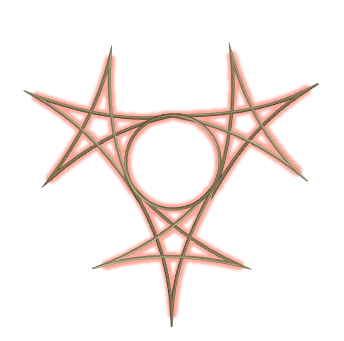
The wickets group themselves into 3 around each Kirkos creating a Tesserkirkos. The 3 wickets are constructed relative to the 3 Pentenexus (the pentagrams within a Penter) which surround it, of which there are 12. This is the Triaster, below:
The Sphere of Pentegraph has 30 wickets, each wicket has 4 openings for the paths that they shepherd and 4 exits (making 16), and because the paths can have 2 directions, there are 32 possible routes through each wicket. The 30 wickets of the Pentegraph Orb can serve as a coordinate system allowing the programming of any path within the Orb.
The blue circle below shows the Dodekakirkos Kirkos of the Penter Enkirkos, which has 5 wickets which intersect with the 5 circles inside it. There are 12 of these blue circles in a sphere.
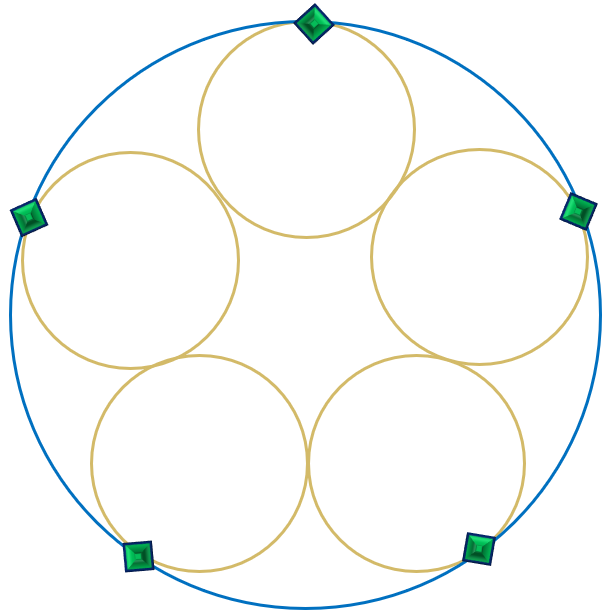
The 10 Wickets of the Pentekirkos Enkirkos

There are 4 Kirkoi to each Wicket – 2 Dodekakirkos and 2 Eikosakirkos Kirkoi (blue and yellow circles respectively), as can be seen in the centre wicket below.
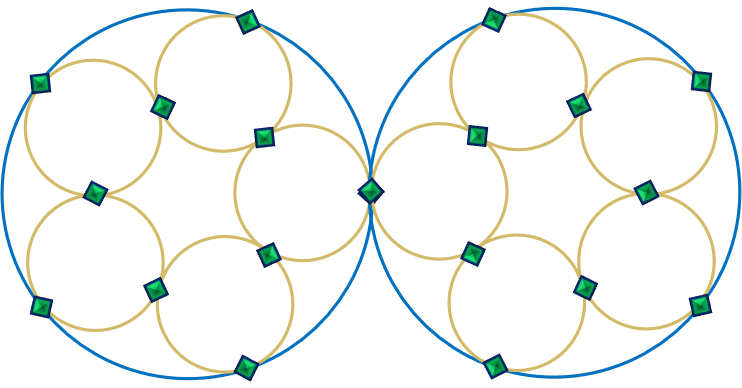
The centre wicket in the diagram above is representative of all the wickets in the Orb, and counting the options available shows that there are 32 possible pathways for each wicket. With there being a total of 30 wickets in the Orb, each having 32 pathways, a grand total of 960 possible permutations is produced. Each wicket will allow only 4 choices on the path that you are following, but the winding permutations throughout the Pentegraph Orb are inexhaustible.
Pentegraph Orb with Wickets
~
The Orb of Wickets
The Orb of Wickets produces 12 pentagons and 20 triangles from connecting up the wickets, and when the circles are replaced with straight connecting lines between each wicket, an icosidodecahedron is formed.
Icosidodecahedron.
The Wickets also separately produce 5 parallel horizontal axial bands (the latitudinal lines shown below); the central equatorial band contains 10 wickets, while the other bands contain 5 wickets each. The bands either side of the equatorial band are the duplicated Upper and Lower Axial Bands of the Dodekakirkos Orb, while the top and bottom bands are produced in the apocryphal Dodekakirkos Osculated Orb. None of these configurations produce the osculation necessary for Pentegraph praxis, yet they are invaluable for establishing a coordinate system.
Wicket Latitudinal lines
From top to bottom, the latitudinal lines are called:
- Zenith Band: Z1-Z5
- Anabasis Band: A1-A5
- Equatorial Band: E1-E10
- Katabasis Band: K1-K5
- Nadir Band: N1-N5
•••
Wicket Longitudinal lines
There are 5 longitudinal lines (none of which intersect the poles and are therefore diagonal across the orb) which determine the naming of the wickets by producing the ordinal number where they intersect with the Axial bands (latitudinal lines). Each of these longitudinal lines is a great circle and has 10 wickets. By choosing the first wicket in the Zenith Band, and following its longitudinal line, the first wicket in each of the Bands is determined.
With this coordinate system it is achievable to document and define all the Pentegraph techniques, and all the paths that are possible within the Pentegraph Orb.
There are 10 different starting points to each Penter, and 12 different Penters in an orb. A Penter is able to be described with 30 coordinates, and is exemplified below:
K5,N4,N5,E10,A1,E1,N5,N1,K1,K5,E9,E10,K1,E2,E1,N5,N4,
K5,E1,A1,E10,K1,N1,N5,E10,E9,K5,E1,E2,K1,K5
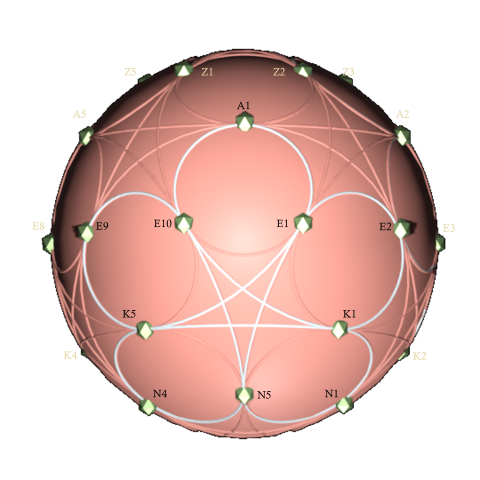
It will be observed in the Globe of pentagrams below (the Dodekakirkos Orb) that each pentagram has tips of Wickets — just like it does in the Aster — and effectively shows how the Wickets group into 5's just like the other orbs do. Five: the magic number of the sphere.
Dodekakirkos Orb Wickets
~
Digital and Robotic Applications
Although the Wicket coordinate system is pretty indecipherable to a human, it could be a significant capability to AI and robotics. This system extends beyond human performance. The precision of these wickets transforms the orb into a programmable grid — a syntax for movement. Here lies the mechanism to program choreography for 3D animated avatars or their non-virtual counterparts in robotics. It bridges the gap between ancient sacred geometry and the digital future of modern technology, acting as a universal interface for defined motion in three-dimensional space.
•••
The 5 longitudinal lines together with the Equatorial Band, form the Exakirkos Decussated (shown below), consisting of 6 circles that cross each other upon a sphere and produce 12 pentagons and 20 triangles and is the spherical tiling of an icosidodecahedron.
The Exakirkos
The Exakirkos Decussated is a sterile structure because there is no osculation within it, and hence it is categorised as an Apocryphal Orb within the Pentegraph system. It is the only orb within the system that bisects the sphere into two hemispheres via a 'Great Circle'. This bisection anchors it in conventional geometry, providing a standard mathematical definition. In contrast, true Pentegraph Orbs possess no such static equator from which to ground their mathematics, allowing for an uninterrupted, flowing asymmetry. It also means that they are not documented elsewhere!
~
The Aster Wickets
The Aster is literally made out of 5 circles and at every point of osculation there is a Wicket (where the path intersects with another part of the path) which allows for there to be a swapping between circles to create the path. In the continual path of the Aster, the Wicket can instantiate a reversal of the direction, and allow for one circle to be perpetually drawn, effectively pausing the continuation of the Asterial Gyre or reversing it altogether.
The Aster Wickets
At every point of osculation (where the circles join), a Wicket is formed, allowing for a seamless transition providing a continuous route around the sphere. Each Wicket is a constraining and forcing of the path around the sphere. Without this constraint it would just spiral off. It takes 5 Wickets to create the Aster out of 5 circles.
The path between each Wicket is called an Arc, and so there is a change of Kirkos half way through each Kirkos. The Wickets are like magnets, and whenever a circle touches one it is drawn into the other circle.

The Asters arcs start and end at a wicket, each with an ingress and egress, making 10 arcs in total. The entire Aster Gyre follows the following sequence for a right handed prime performance:
- Spine to Right Tine
- Right Tine to Quoin
- Left Quoin to Quoin, or Left Horizontal
- Right Quoin to Tine
- Left Tine to Spine
This will be repeated to complete the Aster. The second time around will have opposite ingress and egress arcs. The left hand's Asterial Prime has the following sequence:
- Spine to Left Tine
- Left Tine to Quoin
- Right Quoin to Quoin, or Right Horizontal
- Left Quoin to Tine
- Right Tine to Spine

The Katabasis Aster above, shows that the naming of the points of the pentagram (where the wickets lie) are kept relative to their positioning within the Anabasis Aster; Tine, Quoin, and Spine.
•••
The Aster is 5 interlocking circles, bifurcating at their points of osculation, allowing a continuous path around a sphere. The path of the Aster has to have something influencing it, otherwise it would just be a circle or a spiral. Each comprising circle has the influence of an entelechic twist which makes it bifurcate to its adjacent circle, with their points of touching being the Wickets that drive the path around the sphere.
The direction of the path (of which there are 2) around the Aster is known as the Ambit. The direction the path is taking along the horizontal axis (Quoin to Quoin) of the Aster (whether Anabasis or Katabasis), reveals whether it is a left or right ambit. It is a left ambit if it is travelling from a right Quoin to a left Quoin (which will be both egress and ingress of the full Aster's circumambulation).
Breathing can be synchronised with each Arc if performed slowly, with there being an in breath or an out breath (corresponding to the egress or ingress of the arc) producing 10 breaths per Aster completion. If the breath is synchronised with the Stroke instead of the Arc, then 5 breaths per Aster; if 1½ Arcs then it will take 10 breaths before it repeats and 2 Asters will have been performed.
The Aster within the Orb
The Orb of Wickets is the only orb that produces any significant alignment with the Aster when overlaid. Other than the 5 osculating wickets of the Aster itself, it also aligns with 10 other wickets, albeit non-osculating and a little skewed. The fact that it aligns with 15 wickets (half of the total number of wickets in an orb) is something, though I don't know what.
The Aster within the Orb of Wickets
~
This wicket system is not merely symbolic; it is a coordinate language of flow. The geometry provides the precise syntax for programming complex, continuous choreography — not just for human movement, but for 3D animated avatars and their non-virtual counterparts in robotics. It bridges the gap between ancient geometry and modern physical computing, acting as a universal interface for defining and controlling motion in three-dimensional space with unprecedented precision.