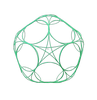
Esokirkos
Inner Circle

Known as the Aster because of its star appearance, the Esokirkos is Greek for "Inner Circle", and so named because of its relationship within the Pentegraph Orb. This is One Turning in 3 dimensions: a sacred path of the universe.
In 2 dimensions, a circle requires just one revolution to return to its start. The shortest distance using 3 dimensions takes 5 revolutions to return to the start of the circle. The circle's curvature is maintained all along the path as it twists in 3 dimensions; a perpetual helix curving back in upon itself.

It is the path of a very fundamental aspect of space — the encircling path around a sphere. The pentagram is the two dimensional template for this three dimensional circle.
The pentagram is pivotal to Pentegraph, underlying all the formations that circles use to division a sphere. Tracing this 3D circle with your hand is a technique I call the Esokirkos or Aster, and is the performance of sacred geometry; it is a fundamental pattern of the universe, and is significant for that reason. In Megâk, the sign can be used as a key to unlock the universe for you, and in my book ‘One Turning’ it is the sign I use to represent the universe.
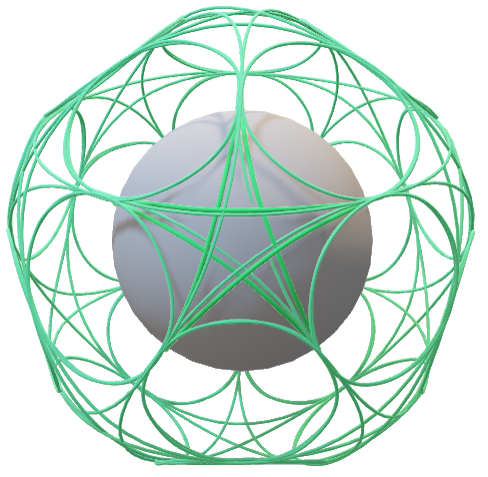
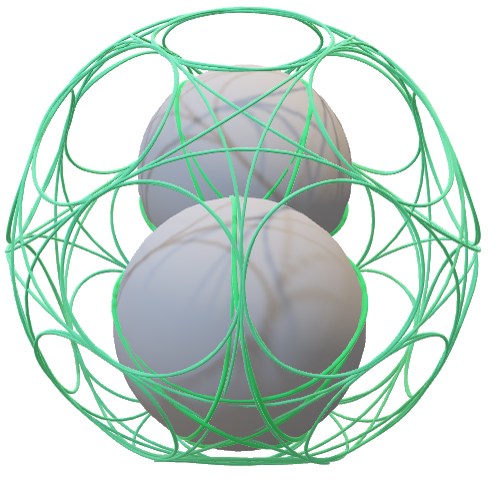
The pentagram is like a shadow of an inter-planal 3 dimensional circle, cast upon the inside surface of a sphere.
The pentagrams that appear upon the surface of the Pentegraph Orb are the templates for the Inner Circle or Esokirkos which form to the size of the radius of the Orb. When standing inside the Orb, it is easy to see why it is an inner circle, as it literally is. A hidden circle inside the Orb accessed from the arcane pentagram etched upon its surface.
It is the pentagram that forms the template for performing a continuous encirclement in 3 dimensions. Five is the least amount of times you can go around in 3 dimensions and end up back where you started.
A normal circle is the shortest encirclement, but it does so in only 2 dimensions. To add the 3rd dimension requires a twist to it and offset, and this produces a minimum of 5 encirclings before completion of the form and the manifestation of a pentagram in its making. This is significant; this is the sign of the pentagram and its meaning.
Using the pentagram as a template, so that when you trace a 3D path of a continuous encirclement wrapping around a sphere, the hand that is doing the tracing never leaves the lines of the pentagram, from the viewpoint of your eye. This allows accurate tracing in 2 dimensions due to having a defined constraint, while the 3rd dimension can only be approximated, but can be fairly easily represented because of the circular nature within the scope.
This is the performance of sacred geometry; it is a fundamental pattern of the universe, and one that can be enacted. Five circles positioned together and performed as a constrained spherical helix.
~
The Aster's path is a continuous, smooth, and fluid path composed of five interlocking circles. At every point of osculation (where the circles join), a Wicket is formed, allowing for a seamless transition providing a continuous route around the sphere. While its path is a composite of these circles, it can be perceived as a Spherical Helix characterized by a constant intrinsic curvature and helical divergence known as the Entelechic Twist. It is the second natural shortest path for circumnavigating a sphere, with no intermediate integer-revolution paths between a single great circle and the Aster.
You have no chance at all of ever being able to perform the technique without using the pentagram as a template, and you might never be able to prove its geometric authenticity without computer models. I think the reason for why there are not any models of this structure preserved in man's history is due to the difficulty in being able to create it. I have only been able to do it because I live in the age of computers. Surprisingly, I have also not seen it demonstrated in any occult or science fiction productions in cinema or TV.
The pentagram is discovered in the Pentegraph Orb from the crossing paths of the rotation of eights within the Penters, which come from the joining of the circles in the Dodekakirkos Orb which encase these Penters and create these crossing paths. The performance of the Esokirkos (Inner Circle), can take place within the Orb where there are 12 of them produced by the ways described above.
~