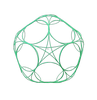
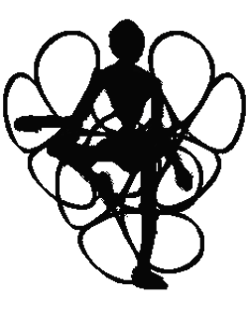
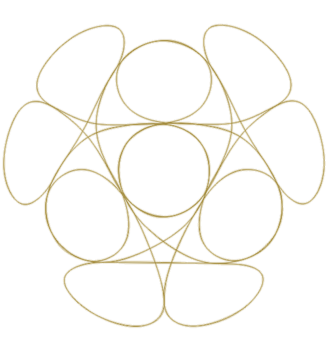
The knee's path is shown by the blue ball in the animation below, or it could be the foot that travels this path.

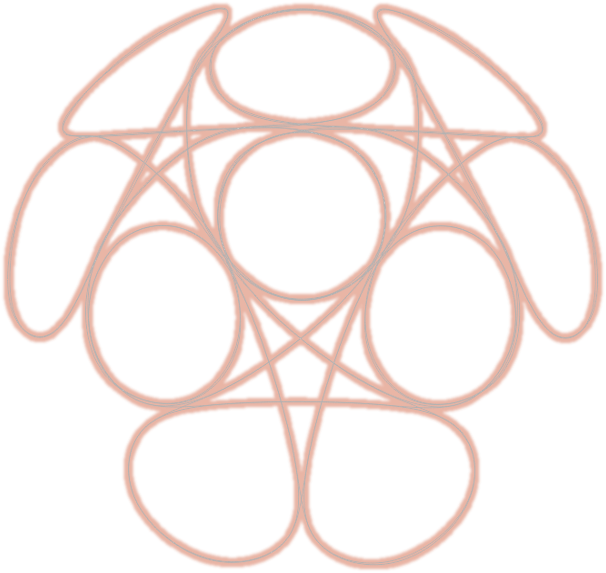

Separating the bottom Penter into the Split Tortoiseshell (below), is the best template to use for practice however, as it allows greater freedom of movement and reduces the required accuracy otherwise needed. The knee or foot is used for the tracing of the bottom Penter, while the hands do the Gate above it.

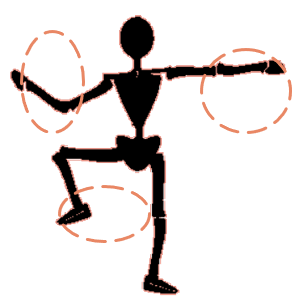
2 hands and 1 knee/foot using the split Tortoiseshell
In the performance of the knee Penters, yoke the foot and the knee together to produce a new activator half way down the shin. First focus on the knee activator then notice the following foot and transfer attention to the foot Penter, and then back to the knee Penter, alternating until an awareness is reached of both at the same time and the central focus point becomes half way between the two.
Due to range restrictions, sometimes the foot will get pulled out of its vertical position, making the foot Penter be skewed, necessitating a focusing at the knee Penter. There are therefore two types of knee Penter: foot down and foot released.
~
The sequence of circles and their rotations in the split Tortoiseshell.

~
The bottom Penter can also be used by the pelvis. For this, the split makes the bottom Penter be performed in the Zedex to the Gate's Exwhy performed by the hands.
In the Tortoiseshell Side Gate, the arms do Whyzed Gates, while the leg does an Exwhy Penter. There is no overlapping of any Penters; the Tortoiseshell is split asunder.
The One Armed Tortoise is the tracing of the Tortoiseshell with just one arm.
The Dying Tortoise is done lying upon ones back with the feet together tracing the lower Penter (using Dolphin Tails), and the arms performing Dragonfly on the Gate.