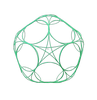
Kirkos
Kirkos is the Greek word for circle.
Circles are the root foundation of Pentegraph. Everything within Pentegraph comprises of circles, and even the connecting pathways between the circles are in themselves just part of greater circles. It is the perfect form in nature together with the sphere, of which it is a flattened form; a 2 dimensional shadow of the cosmic form which all the stars and planets in the universe are made in.
The Kirkos uses 2 dimensional rotations, performed with the hands or Rhabdos.
Because the circle is the least energetic form due to its natural perfect path, it is the path that nature will gravitate towards, naturally creating the necessary body movements to achieve it when enough repetitions have been made. Also, the form of the circle allows the easiest performance with the consequent multitude of repetitions that can be generated from this. The natural body shaking frequency of 8Hz which is resonant with the Earth's Schumann frequency, is a good carrier for producing circles, and is probably the fastest speed that the circles can be performed sensibly.
•••
Practicing the kirkos is essential to perform any of the other artefacts and should be a primary exercise.
Create a circle that has a diameter that is your height times 0.35. This is the size of circle that 20 of them would cluster together to form an orb, which when you stand inside would have the surface touching your outstretched arms. This is the base size circle to practice with. Dot the perimeter of the circle with 10 luminescent stars, and cover 2 thimbles with luminescent material, and place upon a finger of each hand — then switch the light off! This allows the practice for accurately tracing a circle.
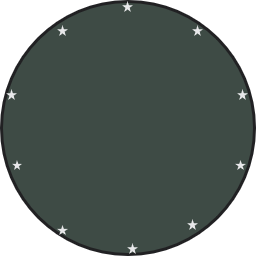
The 10 luminescent stars provide the triggers to inject effort for each circle performed, moving to the next one after each completed circle so that the start of each circle is advanced each time, it taking 10 revolutions before returning to the start. This means the actuating of each circle is from 10 different positions along its circumference.
The power of the Kirkos comes from using both arms simultaneously drawing the circle 180º apart in the same direction, using a circular hikite motion with each hand pulling and pushing the other around. It produces a very powerful effect.
•••
Circles are described in 3 planes: xy, yz and zx.
~
Exwhykirkos
The Exwhykirkos is a circle facing in front of you, like a round window, which you trace with your hands, one hand half a circle behind the other — the Kirkosial Echo. It is the most basic part of the Penters and Gates etc.
It is also possibly the origination for the representation of the Taijitu.
There are a number of ways the Exwhykirkos can be performed:
Exwhyinex, Exwhyinwhy, Exwhyinzed
Exwhyinexwhy, Exwhyinwhyzed, Exwhyinzedex
I only present the Exwhyinzed of these here:
•••
Exwhyinzed
Drawing an Exwhykirkos with feet or hands drawing in the same direction moving back and forth keeping the circle constant to your eye. The hand or foot draws ovals and helix’s but the effect is only circles from the front. When the hands change position, this has the effect of describing figure of eights without any reversal of clock direction.
A martial technique can use one hand being kept behind the other doing circles 180 degrees apart, with the front hand circles larger, powered by smaller rear hand circles using the weighty feeling that the synchronicity produces. This double moment action has great power as the rear hand augments the front even though they are not touching. This circular motion uses the basic principle that an encircling of an attack will block it, and that the production of augmented power using the moment of the supporting hand will reinforce the strength of that block. This technique can be performed very fast. The secondary hand, as well as being an accelerant to the leading hand (due to it performing smaller circles which can be done faster), could even act as a second level of defence in the unlikely event that an attack could penetrate through the leading hand. This is the application of the concept of a shield.
The reversal of the direction of the Kirkos is done using the Zedexwhyzed Aster or the Exwhyzedex Aster, or it can be extended into the Dykirkos and the Penter.
~
Whyzedkirkos
The Whyzedkirkos is a circle edge on parallel to the walls on either side of you, and so the motion around the circle is made away and towards you.
There are three basic methods of synchronizing the two hands as they rotate the Kirkos. The diagrams below show the outer edge of the circles as nearest to you, with the inner edge furthest away.
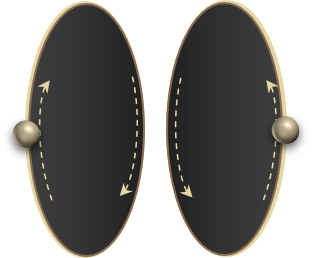
The above method uses both hands rotating in the same direction synchronously in the Hawk style.
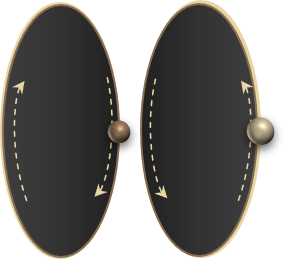
The above technique uses the dragonfly style of asynchronous movement, with one hand half a circle being the other. Both hands are rotating in the same direction as in the preceding method.
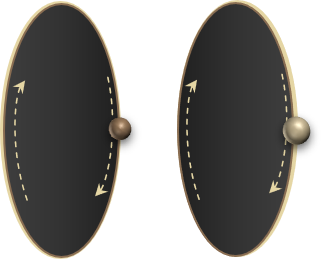
The above is a little more difficult and has the hands moving in the opposite direction, and asynchronously in Dragonfly style.
In all three of the above cases, the rotation can be reversed using an Hemaster, a half Aster.
When two Whyzedkirkoi are performed fast, it is like a hare boxing or possibly digging. When performed with Rhabdos, you should see each head eclipsed by the other when held out in front you
There are a number of ways the Whyzedkirkos can be performed:
Whyzedinex, Whyzedinwhy, Whyzedinzed
Whyzedinexwhy, Whyzedinwhyzed, Whyzedinzedex
I only present the Whyzedinex of these here:
•••
Whyzedinex
This is the performance of the Whyzedkirkos while moving them from side to side.
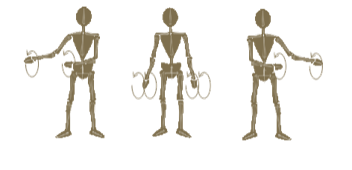 The Whyzedinex is a helix performed in front with the circular motion of the hands going forward and backward, there is no crossover as there can be with the Exwhyinzed and the Zedexinwhy, but instead the helix travels up the arms which are at right angles to the body, each arm circle can be inside the other arm circle. The hand or foot draws ovals and helix’s but the effect is only circles from the side.
Hands keep revolving in the same direction creating a helix which is moved from side to side causing a figure of 8. 2 circles are produced in parallel planes. It is the elbow that pivots the 2 circles
The Whyzedinex uses a crossover in front of the body, with the hands crossing either side of the body, and drawing circles out to side.
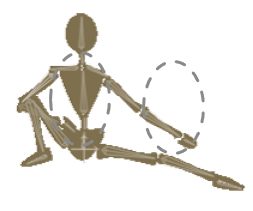
I used to call this technique the Tumbleweed as it is a little evocative of its motion.
The Crouching Tumbleweed
~
Zedexkirkos
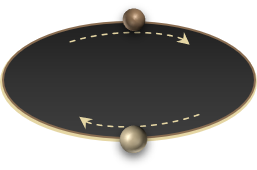
The Zedexkirkos is a circle parallel to the floor.
There are a number of ways the Zedexkirkos can be performed:
Zedexinex, Zedexinwhy, Zedexinzed
Zedexinexwhy, Zedexinwhyzed, Zedexinzedex
I only present the Zedexinwhy of these here:
•••
Zedexinwhy
The helix of the Zedexinwhy is produced vertically, arms on top of one another. I used to call this technique the Lassoo, as it is quite similar to how I believe a lasso is used and certainly feels like it.
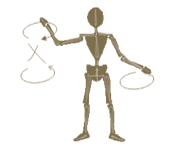 The Zedexinwhy is a helix performed in front or to the side, with the circular motion of the hands going forward and backward and the helix travelling up and down. The hand or foot draws ovals and helix’s but the effect is only circles from above - a birds eye viewpoint.
~
The Kirkos in Pentegraph
The Artefacts of Pentegraph all comprise of Kirkoi. The Kirkos is 1 circle, Dykirkos = 2, Triakirkos = 3, Penter = 5, Gate = 8 (2 Penters, 10 circles, but 2 are overlapped), Tortoiseshell = 10 (3 Penters, 15 circles, with overlapping), Dodekakirkos Orb = 12, Eikosakirkos Orb = 20, while the Aster is effectively the interconnected weaving of five circles.
The Aster can be considered to be 5 bifurcated Kirkoi whose closings into circles is defined by the pentagram, where the visual straight lines that come from an orthographic perspective, provide the view of an edge on template. There are 5 angles the Kirkoi can be drawn in for each of the 3 Asterial Aspects (xyzx, yzxy, zxyz) in both orientations (Anabasis and Katabasis). This produces 30 Kirkosial planes which when performed in their 2 directions (clockwise and anti-clockwise) gives 60 distinct praxis.
Essentially, the Kirkos is just a circle but due to its interconnectivity with other Kirkoi, the strict fullness of the circle is necessarily deviated from to join with the others, as in the Penter. So the strict Kirkos tends to exist within these Artefacts only as a caught repetition before it continues to other places within the Artefact. Whether the concept of Pentegraph is one of it all being circles — and the Artefacts are just means of changing its direction or position — or that the circles are just pauses within the continuous movement of the Artefact, is one of perspective.
Practicing the kirkos is essential to perform any of the other artefacts and should be a primary exercise. Martially, the power of the Kirkos is within the hikite — both hands pulling of the other hand around the circle.
Just performing the Kirkos on its own would be enough, and all the rest of Pentegraph is just about connecting these circles together in all the different ways that they can.
•••
The Kirkostu
In the case of the Exwhy Kirkosial Echo — which I call the Kirkostu — the 2 hands tracing one arc behind each other around the circle will have one hand necessarily in front of the other, this leads to the Megaster being the best Asterial structure to use for any transcription to a reversed direction. With there being 2 Asters involved, the hands are able to perform their Kirkoi parallel and synchronously without collision.
The other way of performing the Kirkostu is by using the Footstool Hemaster comprising of 2 Dykirkoi within the Asterial Echo, which necessarily makes the rear Kirkoi be performed at 72º, and ovoid to keep it circular from the front. The 3D interactive model below does not show the Kirkoi that would be overlaid the three arcs.
Reversing the Kirkosial Echo can be via the Whyzedexwhy Megasterial Echo or the Exwhyzedex Megasterial Echo by performing an Hemaster (half Aster) for each hand. It could be seen that the Aster is just the template to change the plane/orientation or direction of the Kirkos. It transpires within Pentegraph that techniques and Artefacts supplant each other in hierarchy, each being more important and fundamental than another depending upon circumstance.
~
Trinity Kirkos
For three circles to be performed simultaneously, at least one foot will be involved, and if standing up, only one foot!
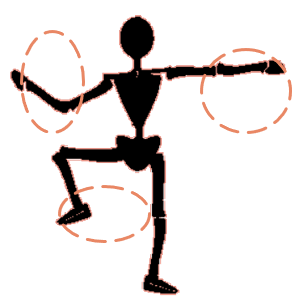
The Trinity Kirkos is mostly applied to configurations that do not depend upon the Pentegraph orb. The free-form useage is frequently reliant upon the arms counter-balancing the movement of the leg's swinging and therefore the Exwhykirkos, Whyzedkirkos and Zedexkirkos of the arms are relative to this.
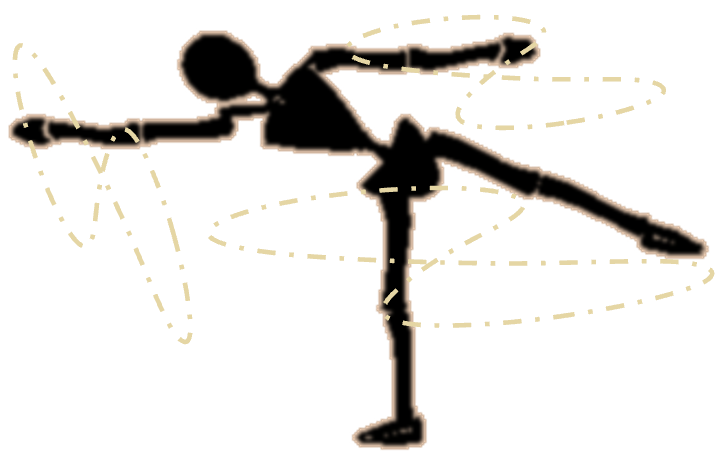
The free-form performance inevitably leads to figure of eights and consequently the term here would be Trinity Dykirkos or Triadykirkos. The Tortoiseshell Dance would come into the category of Trinity Penter as each of the limbs is performing a Penter; that's a very different story!
~
Tethered Kirkos
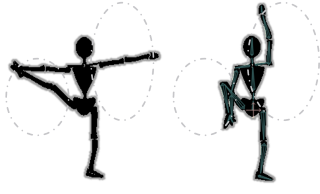
In the Tethered Kirkos, one hand holds the ipsilateral foot and the free arm does a Whyzed Olikos Kirkos while the hand that holds the foot extends out and back while also performing a Kirkos.
~