The Penter
The Penter is the form of the basic path that is interwoven throughout the Pentegraph Orb, comprising of five circles.
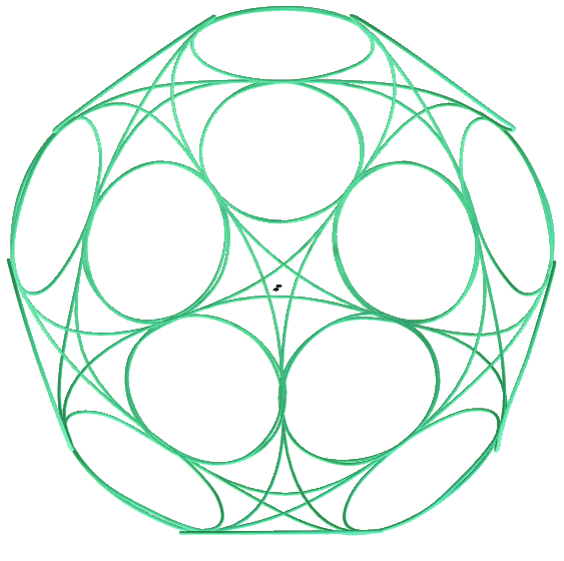
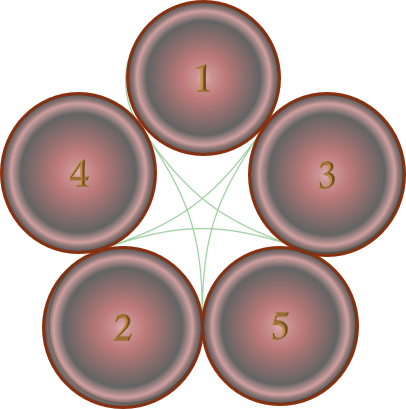
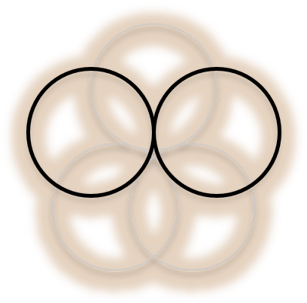
In 2 dimensions, 5 circles can be arranged in 3 ways as demonstrated on the right, moving from overlapping circles (a collapsed Aster), to the Dodekakirkos Penter (with all circles meeting in the middle), to the Eikosakirkos Penter (circles touching).
If circles of the same diameter are placed upon a flat surface, they naturally form into groups of six (7 if you count the one in the middle) — try this with 7 coins of the same denomination upon a table — but on a sphere, the surface is folded inwards, reducing the space available and the circles form into groups of five instead.
The Greek word for five is 'pente', and hence the name Penter is used for this configuration. There are three types: Eikosakirkos Penter, Dodekakirkos Penter and Esokirkos Penter. The latter is also known as the Aster and is an inner circle of the Pentegraph Orb.
~
Eikosakirkos Penter
'Eikosa' is the Greek word for twenty, and 'kirkos' is the Greek word for circle. Twenty circles is one of two basic configurations of an orb comprising of circles on its surface. These twenty circles form into groups of five, called Penters, there being twelve of them in an orb.
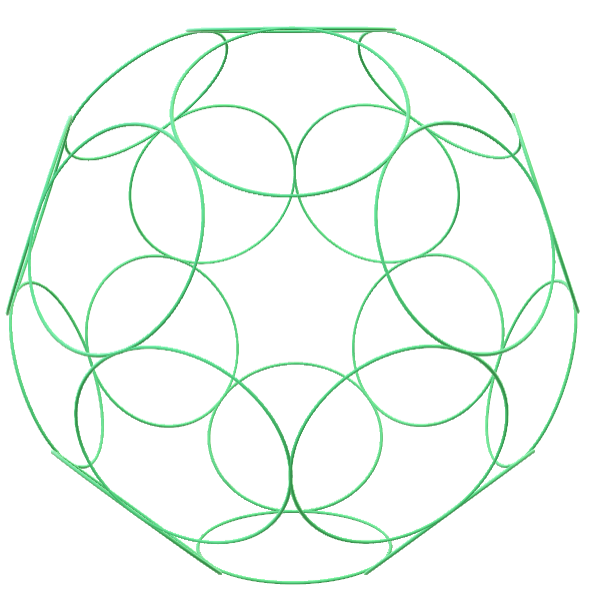
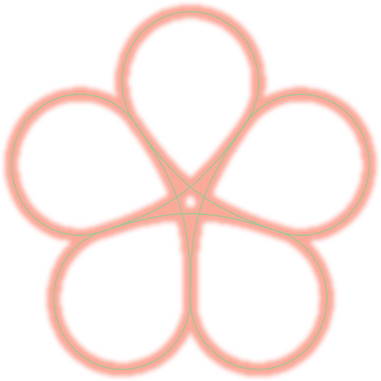
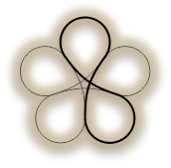
The joining together of the five circles by an interlacing path that travels around the Penter while producing figures of eight '8', results in these two types shown opposite. The pentagrams which emerge from this (called the Pentenexus) are also the result from the encircling of each Penter which creates the Dodekakirkos Orb of 12 circles (above right).
The Upper Penter or Anabasis Penter (right), and the Lower Penter or Katabasis Penter (left), are the positions in which they are discovered above and below the equator of the Pentegraph Orb. This produces the Penter's central pentagrams to have a point up aspect (Anabasis) in the upper hemisphere of the orb, and a downward pointing aspect (Katabasis) in the lower hemisphere. The respective good and bad association with this orientation (which has no historical validity and is quite recent in its invention), could encourage a corresponding mythical interpretation such as angels above and demons below. Which would be interesting (but non-sensical), as these two aspects persist regardless of the orientation of the orb.
Two revolutions around the Penter are required before the path can be repeated, each circle getting a clockwise and anti-clockwise treatment and therefore 10 circles are performed each time it is completed.
There is x, y and z in the path of an Esokirkos (The Aster), but there's only x and y on the surface of a sphere, because the z is fixed at the fulcrum of the socket joint of the arm which is at the centre of the Orb. This allows the transforming of some of the patterns of the Pentegraph Orb into 2 dimensions, and therefore make an easier template to use. The Penter and The Gate are two such templates that can be extracted into 2 dimensions.
These templates can be luminous and then traced with luminous fingertips in the dark, allowing a greater efficacy in their performance.
In the above demonstration of the Penterial Echo, the yellow ball (the left hands finger tip), follows the white ball (the right hands finger tip), chasing around the Penter one circle behind. Performed in the dark against a luminous template with luminous thimbles upon the fingers, it produces a dance which is all about how it feels rather than how it looks. It is very different to how it seems to be in the animation, which produces an optical illusion. Pentegraph is mostly for the enjoyment of the practitioner, not for any observer.
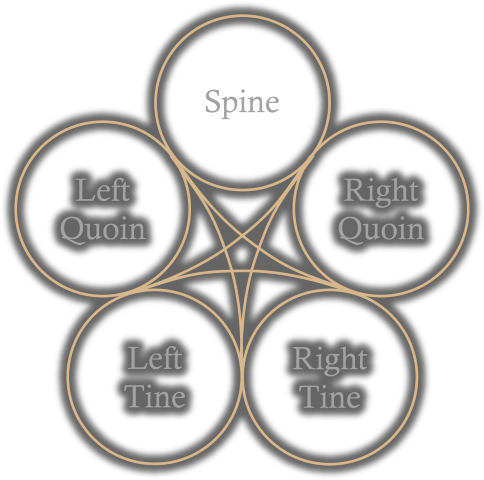
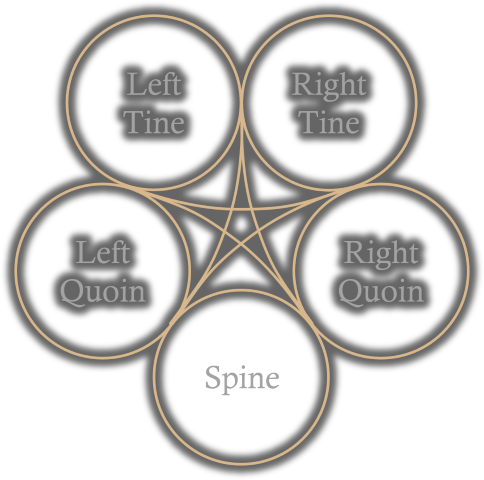
Below is the naming of the circles within the Pentekirkos which maintain their nomenclature in both the Anabasis and Katabasis forms.
~
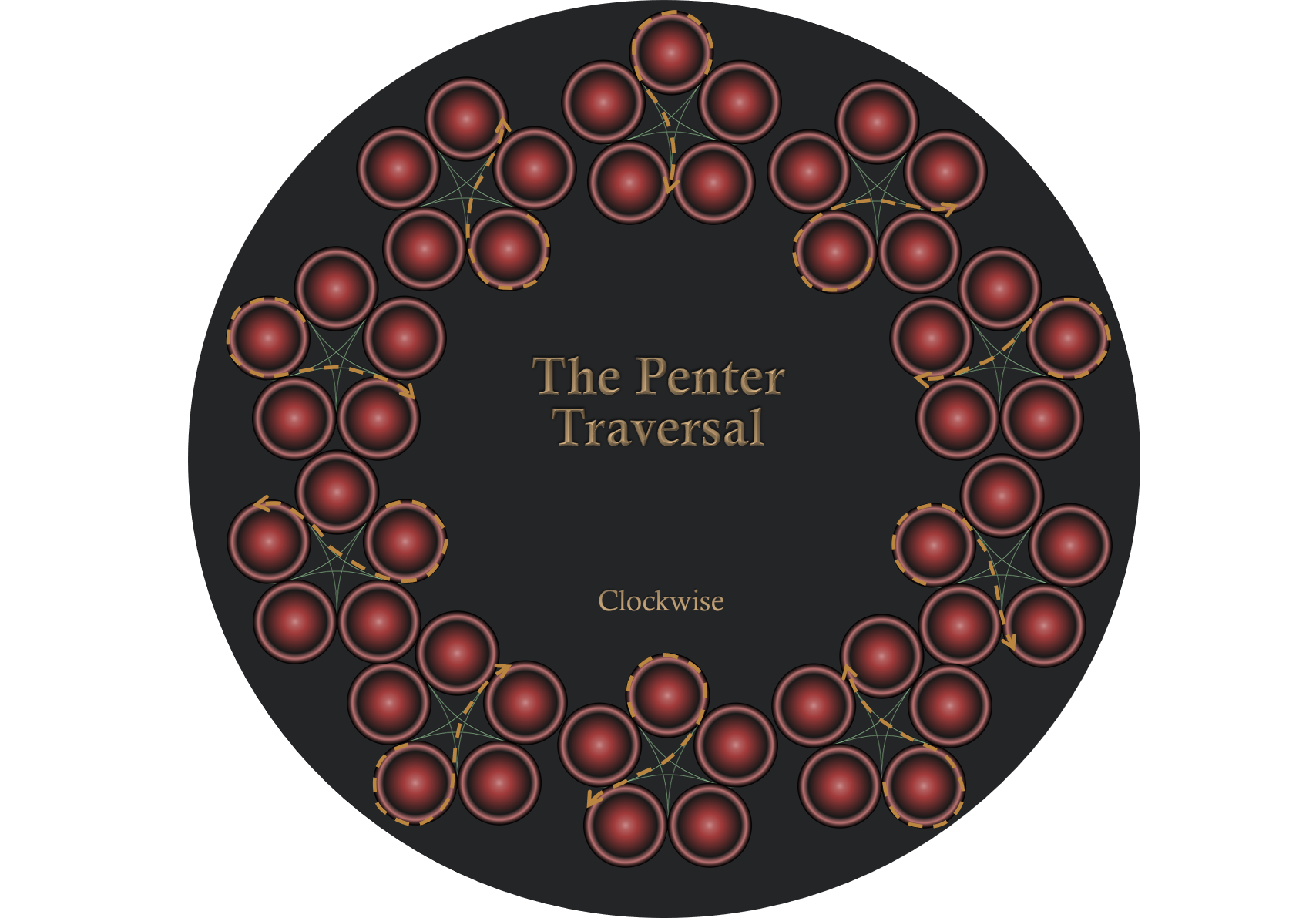
The rotation of "eights" or Dykirkoi, in the Penter traversal.
~
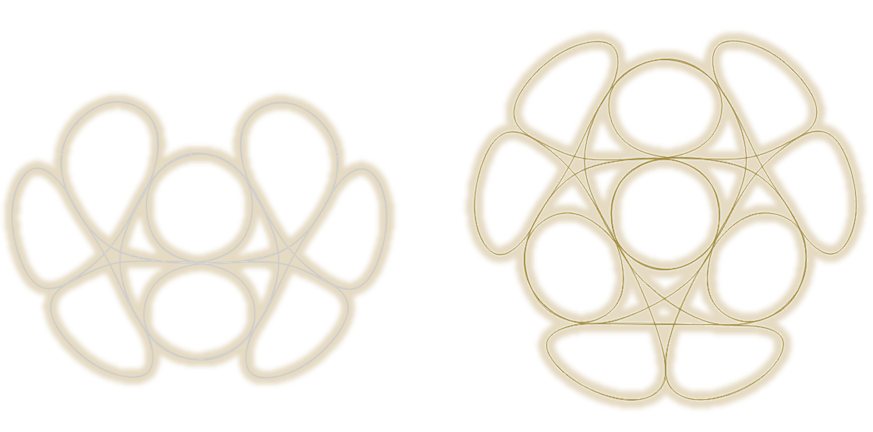
The Penters overlap to form the configurations of The Gate and The Tortoiseshell, shown below respectively.
~
Dodekakirkos Penter
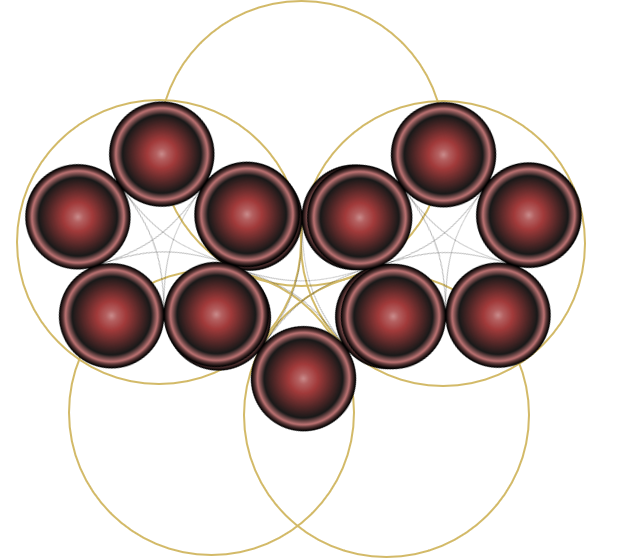
The Penters that are constructed from the circles that enclose the Eikosakirkos Penters (the Pentekirkos), are the same Penter that are the circles that go to form the pentagrams within each Penter (the Pentenexus). There are 12 of these circles within the Dodekakirkos Orb (shown below), and they form 12 Penters.
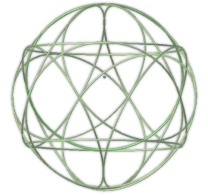
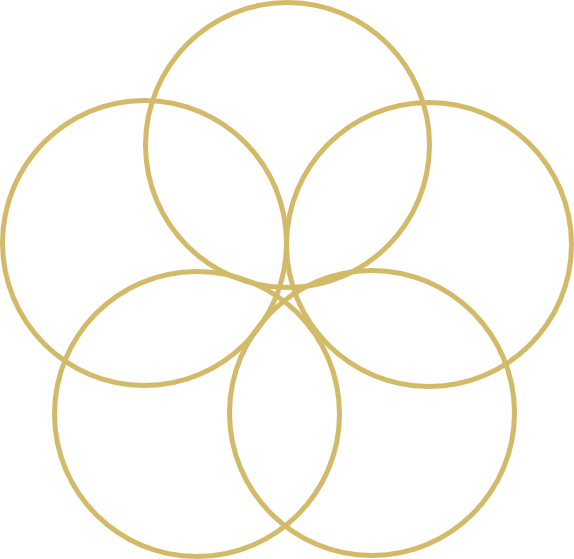
The flattened view of the Dodekakirkos Penter above, is considerably distorted from the 3D construction — as interaction with the model below will show — but is still valid for some performances.
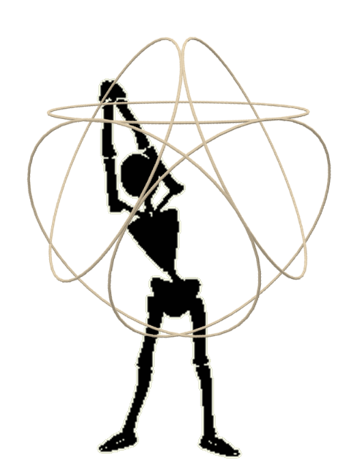
The Dodekakirkos Penter Pelekan
•••
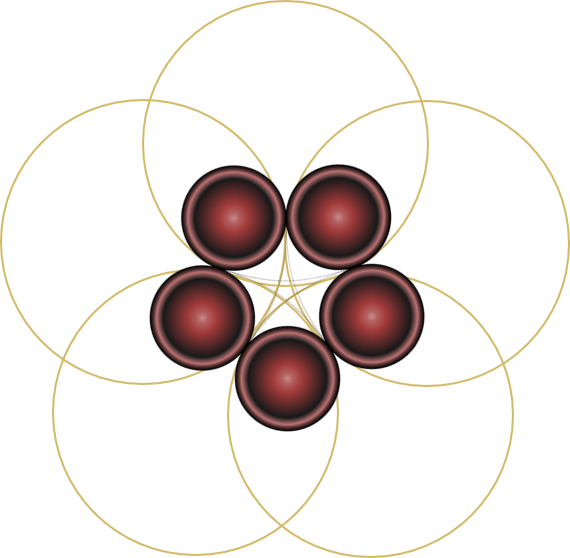
The flattened picture below shows how the Dodekakirkos Penter (5 big circles), interact with the Eikosakirkos Penter in the middle, and how it is the conjoining circles of the Dodekakirkos Penter which forms the pentagram of the Pentenexus in the centre, and creates the paths for traversing the Penter.
~
The Dykirkos in the Dodekakirkos Penter