Breathing
There is a tendency for the breathing habit to become shallow and uneven. When this is corrected into being even and full, after a while there is a noticeable change in awareness, allowing the accompanying correction of relaxation throughout the body which in turn brings attention back to the easy breathing that is happening. It's all part of the same thing.
Focus upon breathing in and out through the nose, slowly and peacefully. At the point that you would normally stop breathing in and start breathing out, instead continue to breath in. Don't force it, keep it smooth and slow and silent. Double the length of the in breath.
At the start of the breath, allow your lower tummy to softly expand out as the diaphragm moves the intestines downwards. The act of breathing is a massage of the internal organs, keeping their motility which is essential to their health.
As you breathe out through the nose, make sure that there is no jerkiness to it, but is smooth and even and slow. It should be inaudible. Any noticing of sound being produced is because it is laboured due to tension. It should be effortless and so soft that it is hardly noticeable. Relaxing will allow this to happen. To be able to do this requires concentrated attention upon the activity. As soon as you start to think about something, your breath will return to its old ways — you will hear it. If you find this difficult you can breathe out through the mouth instead, feeling it soft and flowing.
Notice where there is tension in the body when you correct your breathing. Feel your jaw loosen and your shoulders drop and your belly moving in and out. Feel your cheek bones beneath your eyes. Find somewhere in your body to relax if there is a bumpiness to the breath, that stops that irregularity. Relax the face and neck. Feel the breath soft and silky in the air passage ways and melt into what in actuality is the holy spirit.
It is all about becoming more sensitive to the feeling, and by doing so you will find what works best for you and realise that this is the best exercise ever.
The breath will need to be corrected continually through the day, but it is always there as a method to calm oneself, a sanctuary from anxiety, which is under your control and instantly available whenever you want it.
The mind will harmonize with the breath, the breath will harmonize with the relaxation of the body. All three are connected and will affect each other. When all 3 are in sync, that state is a state of love, and the nicest place to be. It is worth the effort to attain this most basic state of being, and doing so will reveal that it is in fact actually entirely effortless. The breath can become so soft and silent that it is difficult to notice that you are breathing at all.
It is quite likely that the meditation will release normal controls and you will find on certain days that you will get angry at some things for seemingly no reason, but this will pass and is just part of the process.
~
Whyzed Exwhyzedex
or
Hidden Tigerlily
Breathing accompanies everything that we do, and so we can harmonise its rhythm with other actions. By performing a movement while doing synchronous breathing, a yoke (the same word as yoga), is created, strengthening the activity.
The Whyzed Exwhyzedex (yz – xy – zx), is a form of Penter performed together with a specific breathing to it and uses xy and zx Kirkoi within a yz rotation Penter. Drag the interactive 3D model below to get a better understanding of the structure. This is the path that one hand will take.
Performed with both hands in the style of the Hawk and executed in the manner of Qi gong, it encourages a rooted stance with an energetic breathing in through the nose and a powerful strained out breath through the mouth, while being performed slowly. The top Kirkoi are level with the shoulders.
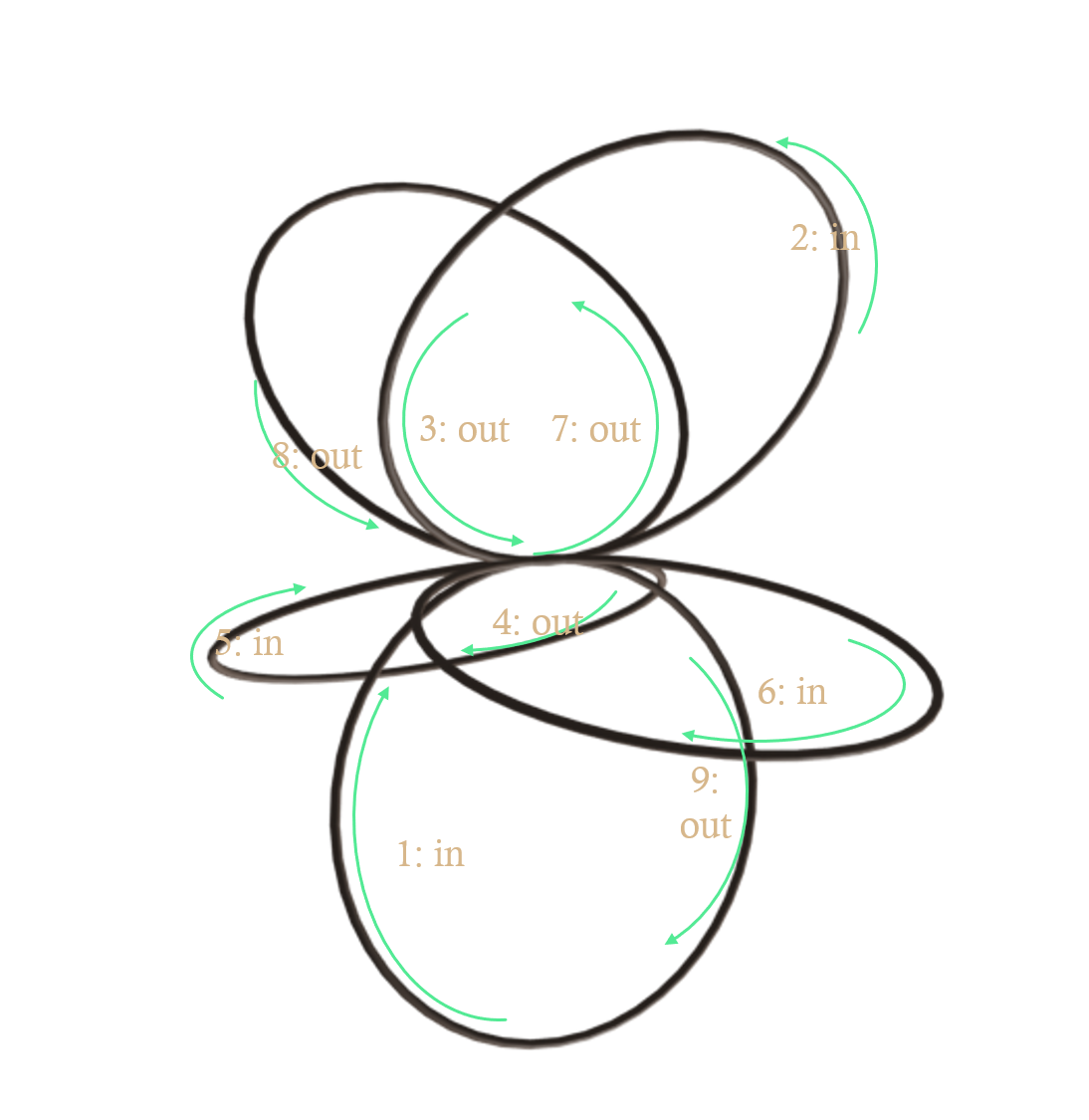
Above shows the right hands movement in combination with the in and out breathing. The left hand does the same in the opposite direction simultaneously with the right hand. The circles are directly in front of you but shown here at an angle for purposes of clarity; it all looks far more complicated than it actually is.
The ‘1’ and ‘2’ in breath ends with the elbows pointing downwards and the palms facing forwards, fingertips pointing up and as close to the shoulders as possible with the chest opened out. The ‘3’ and ‘4’ out breath is done forcibly, restraining the amount of air exhaled and with a resistive feel to the action, as if the hands are pushing against something. This can be done with a hissing sound — ‘ssss’. The body will tense and settle into the lower abdomen from there becoming rooted in the pelvis. The ‘5’ and ‘6’ breathing in, should bring your elbows as far back as they will go, forcing the chest open to achieve a fuller breath. Because an ‘in’ and ‘out’ breath equals an even number, the 5 circles have to be truncated and reduced to 4 resulting in the 2nd out breath traversing 2 circles (the ‘7’, ‘8’ and ‘9’ arrows above). Using the ‘orb’ sound during the breathing out, strengthens the stance and summons the Observer.
The ‘orb’ sound is like a growl, strongly feeling it at the Dantien, drawing the power down to this centre of gravity, to a feeling of strength and stability. This power can be tied down with the Sacral Aster, pulling the consciousness in this area even lower to counter the natural tendency for it to rise up. The circulating involved with the performance of the Aster, is a consolidating of the power paradigm. The energy in this centre is from the focussing and consciousness placed here and coupled/yoked, with the breath and physical rooting and the harmony that this produces which realises confidence and self-assurity.
~
Stairwalk
Of course one of the best ways of increasing oxygen intake is to do an exercise causing heavy breathing. One easy way of doing that is to go up and down the stairs on all fours, forwards and backwards, with the body upright.
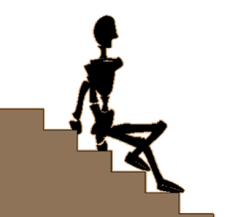 The Crab (as this is also known), can be performed blind as you do not need to see anything during its performance — because you are not going to run into anything, and you will notice when you get to the bottom or the top — so by shutting the eyes more consciousness is used in the proprioception. A different world with its own feel.
It is even possible to develop a different ego in the environment of the stairs whilst doing the Crab. The ego is not really human due to the form of the locomotion and the eyes being closed. All this helps to distract from any exhaustion the exercise produces.
You will most likely hurt yourself at first until you learn to keep constant attention focussed upon the hands and their movement, rather than the legs, and just let the feet do what they need to, to keep up. As your arms tire, it is easy to miss a step as you go up the stairs, with the result of grazed forearms. You soon learn to do it properly.
After sufficient practice it is best to concentrate on the centre of gravity. I have found that the centre of gravity is much higher in this method of locomotion (dependent upon the height of the steps), rising up to the chest and the Thoracic Aster or the 'R' within the middle Mirror, which if the focus of attention is placed here, the movement becomes much more stable and able to be performed more quickly, just like normal upright movement is stronger when focussing upon the Dantien — the 'O' of the lower Mirror, the Observer.
The mental concentration and focus upon the feeling occurring during the motion, that is being produced in an unusual way, detracts you from becoming too aware of the physical exertion, allowing you to do more.
It doesn't take a great deal of effort, but quickly tires you and causes a lot of heavy breathing, presumably because you are using your arms to do part of the work normally only the legs would do. The legs are much bigger than the arms and can do more work before exhaustion; this efficiency is not what you want if you want to increase cardiovascular activity. You don't have to run miles to keep fit, you can do it in your own house — unless you live in a bungalow!