Rhabdos
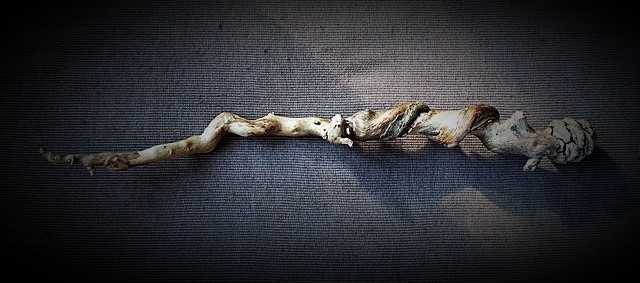
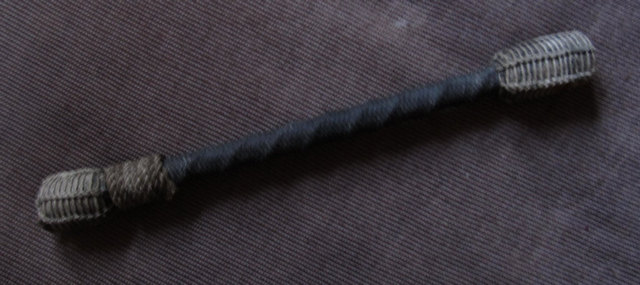
Rhabdos is the Greek word for a "stick" or "wand". It is from the Proto Indo-European root meaning "to turn". In Pentegraph it refers to the activity of rotating a stick in the hand, between the fingers or within the hands. Rhabdos is the singular form, Rhabdoi being the plural.
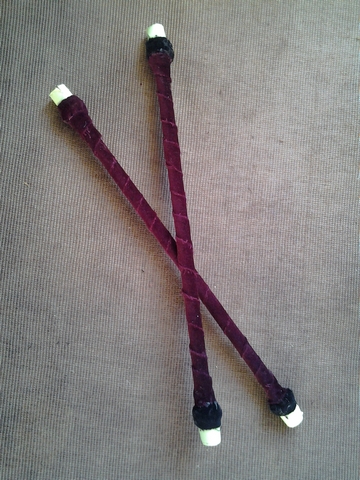
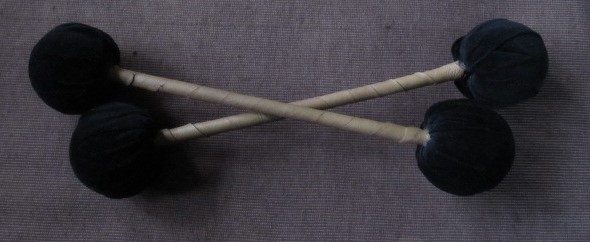 I sometimes call the performance "mousewheels" because when the momentum is achieved to twirl them effectively, they seem to rotate in the fingers on their own accord, and is perhaps how a mouse feels while it is running in its mouse wheel. It is effortless and self-perpetuating and has a good feeling.
The Rhabdos can be used by holding the Rhabdos at one end and tracing out a Penter with the other end (in a classic style of wand waving but with true geometric validity), or it can be revolved by two hands holding it in the centre of the Rhabdos or with a hand at each end, or by one hand only holding it in the middle. Always the greater pattern that is performed is a Penter or Aster, with the Exwhy's, Whyzed's and Zedex's used as pauses within them. Or it could be thought of as being all Exwhy's, Whyzed's and Zedex's, and the Penters and Asters are the means of reversing their motion.
~
We have been built by nature to be this physical thing we are. You let nature do its thing and it creates you. You learn to do something by putting yourself in the situation that demands that you do the thing that is necessary in that circumstance to achieve it. In the case of Rhabdos you get the stick to rotate in your hand and let the fingers assume the necessary positions that they have to, to maintain the action that is happening. You don't really learn how to do it, rather you let nature do its thing and it makes you able to do it and constructs the new reality around you and of you. If you foresaw the result and it later happens, this is what we call free will. It is only a story of what is happening, and you edit the story depending upon what happens.
~
Rhabdosaster

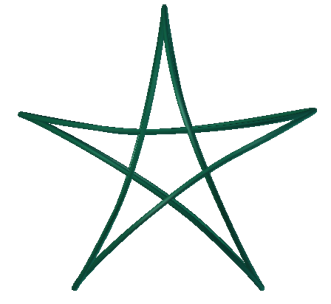

To turn a stick in all 3 directions means to use the geometry of the Aster and the pentagram as the template to guide the action. The Rhabdosaster is the tracing of the Aster with a Rhabdos which is generally performed using the Zedexwhyzed.
The Rhabdosaster can be performed by holding the Rhabdos with a hand at each end and tracing out the Aster with the palms maintaining contact with the Rhabdos all the way through the pattern and therefore train the hands to encircle an imaginary ball. This is the best way to learn how to perform a pentagram in 3 dimensions with the Rhabdos producing the necessary spacing between the hands. There is only one way it can be performed and the Aster combined with the Rhabdos forces the hands to move in the required way, forcing the palms to twist to maintain contact with the intentioned sphere.
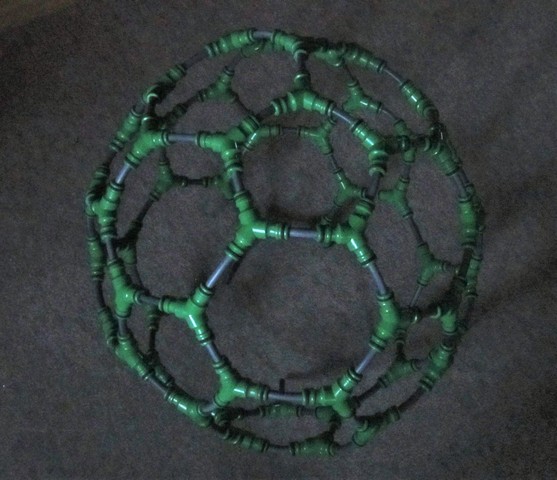
Performed with luminous ends in the dark, the Zedexwhyzed will produce a pentagram for visual display.
The Rhabdosaster effectively performs a double helix in a closed state. The opening of the Aster releases Exwhyinzed's, Whyzedinex's and Zedexinwhy's, tumbling and mutating to produce strands of double helices which the arms travel through space creating. The movements of the arms themselves would be based upon the paths presented within the Pentegraph Orb. When the arms finish their pattern, the holding position or pause within the movement uses the Rhabdosaster. The Rhabdosaster is the core hub from which the movement of helices can be propagated. The reversing in direction is achieved by using an Hemaster, which is half an Aster.
A secret technique is often secret because it is difficult to teach and no one knows it. When something is easy to teach, everyone can know it and it is not secret. A secret is often being kept from you because no one can tell you, not because you shouldn't know. It is like the Rhabdosaster and the pentagram that it creates from its performance: it is a secret technique that no one else is able to do and so no one else can tell you about it. It will stay secret if I cannot teach it to someone, and therefore it may enter into the realms of the occult: hidden, not because it is being concealed but just because no one can see it.
~

Other than the Rhabdosaster, there are three main performances which involve the twirling of the Rhabdos: Rhabdosexwhy, Rhabdoswhyzed, and Rhabdoszedex, each with an inwards and outwards, and clockwise and counter-clockwise aspect. These are performed in only 2 dimensions and effectively dissect a sphere into two. To dissect a sphere into more than two reveals the 5 encirclings of the Aster.
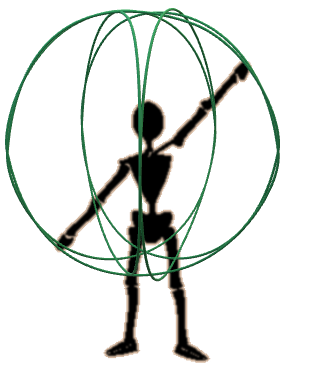
The Rhabdosaster is also a diagram showing the Condoraster, where the stick would be the outstretched arms and the balls on the end would be the hands. Shown above is the Whyzedexwhy, and it forces the body to contort out of the way of the arms as they make their way along the path.
The central pivot is the clavicular joint at the sternum, which remains at the centre of the Aster, with the hands tracing the path of the Aster 180º apart. It is not possible to keep the body stationary during this performance, and it is the arms only that trace the path, with the feet and body moving necessarily to where they are needed to be to achieve the movement, twisting and contorting just to get out of the way. It can make me feel a bit dizzy and disoriented and is quite testing.
This path could be a good design for a roller-coaster; it would certainly make me sick!
~
Rhabdospenter
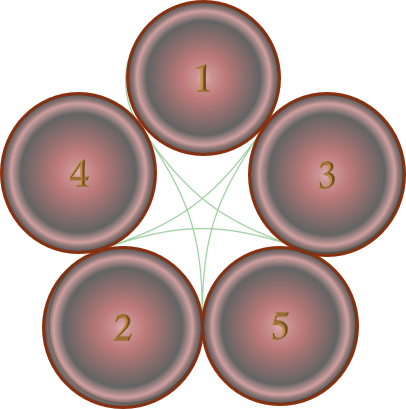
This is generally performed by holding the Rhabdos at one end and tracing out the Penter with the other end. The Penter can also be used as the movement path taken while performing Rhabdosexwhy, Rhabdoswhyzed, and Rhabdoszedex. The Penter provides a constraint to what would otherwise be a free-form and aimless exercise. The pattern also provides an ever changing direction within which to pursue the practicing of the turning of the Rhabdos.
This could be used as a fencing or other sword fighting defence, which if performed with sufficient speed should provide an impenetrable barrier.
~
Rhabdosdykirkos
The Rhabdos Yinyang has the Rhabdos held in the middle with the 2 ends rotating to produce 2 points chasing each other in an Exwhy as seen from the front. The Rhabdos does not twirl through the fingers like in other performances, but instead is merely balanced in the hand as it rotates. This is a performance of the Taijitu seen on the right.
The Rhabdosdykirkos (left), is also held in the middle and performs a figure of eight while mainting its face towards the fromt.
~
Pentegraph Sex
If the pelvis performs an Aster, then it is producing the drawing of a pentagram, and therefore it is possible to wish upon this star. In an amorous situation the male phalos can be a Rhabdos, and be like a magic stick.
As it is the pelvis that does the movement, the Aster is suitable for either gender to perform, or both in some form of syncopation. Used for pleasure or as a means to conjure some desired outcome, this is Pentegraph sex magic to be used in conjunction with Megak.
~
Rhabdosorb