The Altar of Megâk
~
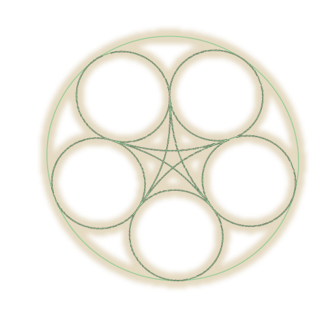
Megâk has the purpose of yoking Pentegraph Artefacts into a magickal performance using mental conceptualising and reinforcing of affirmations. The basic mechanism for doing this is the Penter and as such is the Altar of Megâk.

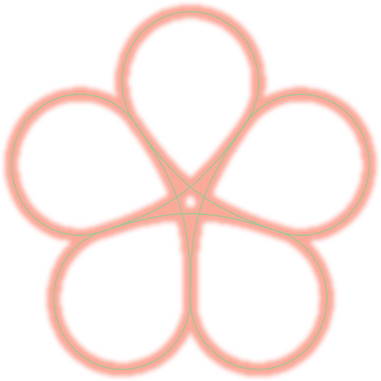

This symbol is the basic part from which all the other artefacts are made. It is the foundation stone and fundamental root of Pentegraph and hence also of Megâk. The performance of two at the same time produces the configurations found in the Gateway and Mirrorway, which have their own respective mental associations and practices.
The Mirrorway leads with the left side and provides the apparatus to envision growth of the personal self. The Gateway leads with the right and composes and structures the forms interconnecting within the Pentegraph Sphere. Halfway between the two is the Loom which weaves left and right together to dispense with chirality and the limitations that are inherent within a physical world, and prepares for the dream world.
At the heart of all configurations is the Penter, which, as the Altar of Megâk is where we sacrifice our habitual selves and become focussed into silence, relaxation and trust. When the Altar of Megâk is mapped onto the abdomen we have the performance of ORBIT which is a ritual of Self-Form, and this aspect is explored in Yoke.
The ORBIT of Megâk
The fundamental purpose of the Altar of Megâk is the composure of oneself. The composition of the self that is formed at the Altar is one of mental posture and presence — the base state of being, the First Self, a prerequisite for an enlightened state. This is the altar-ego. Sacrifice your old self at the Altar and become renewed and refreshed by re-awakening to your original and pure beginning.
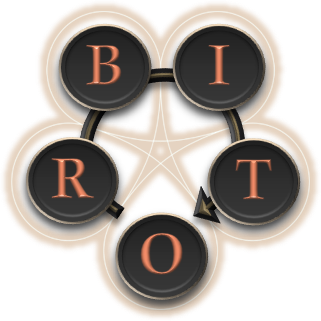
This is the form of the basic path that is interwoven throughout Pentegraph and Megâk. The tracing of this path in the air or on paper is also a meditation. This symbol holds ORBIT, the acronym for Observe, Release, Believe, Integrate and Transcend. This is the way to composure which starts by listening to the inner sound — ‘Observe’, and so enter into meditation, and continuing with relaxation and breathing to ‘Release’ into a state of ‘Belief’, which is the love and trust coming from your ‘Integrated’ and self-connected self so that you can ‘Transcend’ to your greater self. Create a concept of yourself having faith and being love (believing), with the posture of that condition: confident and lucid, having transcended the ego. This is an access to the divine.
The First Self — which is our greater self, and which is at the heart of our endeavour within these methods — is the unsullied god that we all are before our descent into societal integration.
Our intersection with the divine is through our physical manifestation, and by using this physical manifestation to perform paths of divine geometry, we interlink the two worlds and provide a gateway between them. The Altar of Megâk is the platform to the spiritual experience of the divine; its entrancement, the entry into the divine via physical activity.
•••
Our experience of the mundane is with our eyes open, while our entry into the divine every night in our dreams, is with our eyes closed. In the dark, but with our eyes open, and with only the luminous patterns of the Megâk artefacts to see, a compromise of the two dichotomies is produced. The surrealness of the experience produces the necessary breaking from everyday life into the magickal world of Megâk, severing our inculcated domestic habituations and setting us free into unharnessed potentialities.
Tracing the path of a Penter with a luminous thimble in the dark, is a bit like playing an early arcade game with a car going around a track which you have to keep on the white lines. The finger is swung around with momentum having a pendulum-like feeling. With practice, the feeling is like your finger is travelling on rails as it accurately and unerringly follows the lines that are being traced. Performed in the dark, the luminous path that is traced over and over again with a luminous fingertip, is a searing through the darkness like a welders torch cutting through the fabric of reality with an ethereal glowing spirit, brought to life by the experience of the detached sensation of the action. Within this surreality lies the realm of altering reality to what you want it to be.
The trance that results from this activity is a tunnel of spiritual focus producing a frequency of energetic being that fits into the divine paradigm of universal harmony. This fundamental and base state of existence is the state of being that is being desired, and is being created by the performances of Pentegraph and Megâk. The intent and concentration of tracing a path around a Penter, is the meditation that produces the state of being that is linked to the divine.
By diminishing the amount of distraction due to the performance being in the dark, a better focus and absorption in whatever you are doing is accomplished. When it is completely black except for your fingertips and the Pentegraph paths, the only thing you can do is to integrate them by following the path with your fingertips. The disassociation from normality allows a transcendence into the spiritual realm. This is the magick of Pentegraph.
~
The Penteraster
There are two aspects to the Altar of Megâk: the Penter and the Aster within it. There is also the encompassing circle around it called the Pentekirkos. All are paths that can be considered separately, as well as crossed over from one to the other. This is the Penteraster.
Choose, wish, desire and will, all have the same etymological meaning and are the intent behind the performance of the Zedexwhyzed Aster that lies at the heart of the Altar of Megâk. The Zedexwhyzed is the orientation of the Aster at the centre of the Penter and is the star upon which you wish; a wish for lucidity, the catching of our attention and the demanding of concentration and grounding.
Tracing the form of the Penteraster, or just looking at it while practicing the base state of being in ORB, makes the Altar of Megâk become the symbol to associate with composure, stability and centring. This is the hook to lure into any of the other symbols.
Ultimately, the Altar of Megâk is for the transcendence of ego. There can be an almost continuous telling of a story of yourself which is distracting from your true path. It interferes and detours the divine journey. The stories have to stop, and to stop them is to move across — Transcend — to the start of ORBIT, where we Observe in silence the incidental movement of the mind and realise that it is only an unnecessary accompaniment, and this recognition of its unimportance allows us to release ourselves from it and abandon ourselves to the true way.
•••
ORBIT is performed at the Altar to create the aspects of relaxation and focus. It is the method for creating centred presence and composure. It can be a collecting method as a preliminary to performing the Gate, and as a centring ritual to achieve a state of being, conducive to being your true and fuller self.
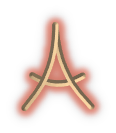
The central Aster could be considered an ‘A’ for Altar. By using the path of the Hemaster (half-Aster), which is travelled between each of the progressions around O-R-B-I-T, an alternate path is created to the usual 8's, and utilises the three dimensional Aster interweaving with the two dimensional Penter.
The animation above shows the Hemaster reversing the direction. In the following animation it instead travels to the next circle of the Penter in the progression of ORBIT.
It should be noted that the Hemaster is a 3D circling coming out of the page at you, while the Penter circles are flat 2D in this representation. If the animation switched onto the outer circle (the Pentekirkos), it would travel it clockwise, showing that this is a dextral performance. The following interactive 3D model shows how the whole thing joins together in actuality.
~
The Observer Sigil

The symbol for ‘consider’ consists of the circle of ‘Observe’ placed below the central Aster of the Penteraster, forming a structure which is a little similar to the globus cruciger of Christianity, but here the cross is the Aster of the First Self above the circle of the lower Dantien, and can have a similar meaning of the god within all of us above the Earthing circle below it. With the word ‘consider’ coming from ‘with star’, and having the meaning of ‘to observe’, the symbol forms the root of the Altar of Megâk and is known as the Observer sigil.
Use it to summon presence and as a means for controlling the haphazard thoughts of a runaway mind. It is the desire for centring and root alignment where the god within us can look out unperturbed and uninterrupted.
~
You don't summon something into this world, you summon yourself out of it. With your self now out of it, the subconscious can get on with doing it. It all works beneath the mind. Summon
comes from 2 Latin words: sub
and men
; beneath the mind
. This is what the word summon means: it means you program the desire and set yourself upon the path, and then forget about it, and magically things will manifest within your life.
But we just produce a story of it, and an optimistic story will help us along our journey and draw us into noticing the little miracles that are constantly occurring, because our lives indeed are little miracles. Even if the magic isn't true and it is only our imagination and wishful thinking at work, then this is a better experience than having no hope. Our minds create our miseries and our joys by its judgements, and sometimes we need something to grasp onto to steady ourselves in the turbulence of happen-stance. Our belief that our path is true and justified, and that we are doing something to make it right, can actually make it all come out right. Perhaps this is the real magic that is really at work — our believing — our being love.
~
The merging of two Altars produces the artefacts of the Gate, Mirror, Loom and Seal.
The Gate to riches
The Mirror to yourself
The Looming of your dreams
The Seal of your approval
